Chinese name: Spearmint
Latin name: Mentha spicata Linn.
Other names: green mint, coriander, savory, green mint, blood coriander , dog meat incense, earth mint
Distribution area: Henan, Hebei, Guangxi, Gui, Yunnan, Gui, Xin etc.
Subject: Lamiaceae Tubular Flower
1. Morphological characteristics of spearmint
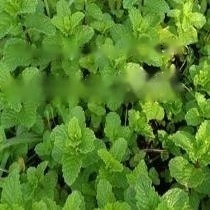
Spearmint is a perennial herb. Stems erect, 40 to 130 cm tall, glabrous or nearly glabrous, green, obtuse quadrangular, grooved and striped, sterile branches only adhering to the ground. Leaves sessile or subsessile, ovate-oblong or oblong-lanceolate, apex acute, base broadly cuneate to suborbicular, margin with sharp and irregular serrations, herbaceous, green above, gray-green below , 6-7 pairs of lateral veins, and the midvein are more or less concave above and below are clearly elevated and whitish. Style protrudes from corolla much, apex equal to 2-lobed, lobes subulate. Plate flat-topped. Ovary brown, glabrous. Flowering July-September.
2. Growth habit of spearmint
Spearmint is a light-loving plant, and its leaves are not only the organ of photosynthesis, but also the main place to store essential oils. If the planting density is too high, the ventilation and light transmission between the plants will be poor, which will lead to high branch nodes, few branches, and easy shedding of leaves, thus affecting the yield and quality of essential oils. Spearmint does not have high soil requirements, preferably sandy and loose soil, and neutral soil with pH. Due to the large biomass of spearmint above ground, the demand for fertilizer, especially nitrogen fertilizer, is large.
3. Cultivation techniques of spearmint
Cultivation techniques of spearmint need to pay attention to the following points. The first is the choice of variety. Spearmint is divided into two varieties: large-leaf and small-leaf. Generally, large-leaf spearmint is selected, which has strong adaptability, fast growth, high oil content in the stem and good quality. The second is the sowing method. Due to the large variation in seed propagation, two methods of rhizome propagation and branch propagation are generally used in production. The last step is cultivating and weeding. When loosening the soil, it is lightly loosened near the plant, and the rows can be deeper. After the rain, the soil is compacted and loosened in time.
Guess you like it
Salvia | Cistanche | | Edelweiss| Cosmos|
Syringa | Venus flytrap| Wild strawberry| Cistanche|
gerbera | white grass | dendrobium | shegan | purple jasmine | duruo | zhe fritillary | petunia |

![[Dog Training 5] The training method of pet dog dining etiquette](/static/img/12192/12192_1.jpg)