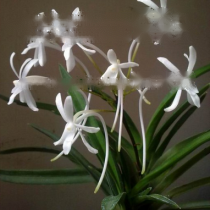
Chinese name: Fenglan
Latin name: Neofinetia falcata (Thunb. ex A. Murray) HH Hu
Family: Orchidaceae
Genus: Wind Orchid
Species: Wind Orchid
1. Appearance Characteristics of Wind Orchid
Wind Orchid is white, fragrant, and very beautiful when it blooms. Plants are 8-10 cm tall. Stems are 1-4 cm long, slightly flattened, and covered by leaf sheaths. The leaves are thick and leathery, narrowly oblong and sickle-shaped, 5-12 cm long, 7-10 mm wide, with subacute apex and V-shaped sheaths that overlap each other at the base. Raceme about 1 cm long, with 2-3 (-5) flowers; bracts ovate-lanceolate, 7-9 mm long, apex acuminate; pedicel and ovary 2.8-5 cm long, with 5 ribs ; Flowers white, fragrant; middle sepals nearly obovate, 8-10 mm long, 2.5-4 mm wide, apex obtuse, with 3 veins; Outwardly curved, with a keel-like bulge near the apex of the middle rib on the back;
2. Maintenance of fenugreek
First, water and fertilizer, whether the water adjustment is appropriate can basically determine whether the fenugreek can be Breeding was successful. It should be noted that excessive fertilization can damage the orchid. When watering the orchid, tap water can not be used directly, but the water that has been connected in advance can be used to water the flowers. Second, the amount of light required by different varietals of the orchid is also different. If the sunlight is strong, it will gradually turn yellow, and the amount of light received needs to be adjusted.
3. The division of wind orchid
The wind orchid is generally divided once every 3 years. In spring and autumn, if the plant grows robustly and densely, it can be divided. The clump should keep at least 5 pseudobulbs linked together. Before the ramets are divided, the irrigation should be reduced, so that the basin soil is less than that. When potting after ramets, first cover the hole at the bottom of the pot with broken tiles, and then spread with coarse stones, accounting for 1/5 to 1/4 of the depth of the pot, then put coarse-grained soil and a small amount of fine soil, and then use rich soil. Planting in sandy loam soil with humus.
Guess you like it
Gerbera| | Ash Tree | White Palm |
Almond Flower | Baiji|
Saffron| Forget-Me-Not| Sunflower| Lily of the Valley| Gardenia| Poppy| Poppy| Rapeseed| Carnation | Chunlan | Jasmine | Osmanthus | Paeonia | Campanulaceae | Datura | Violet | Anthurium | Camellia | Narcissus |

![[Dog Training 5] The training method of pet dog dining etiquette](/static/img/12192/12192_1.jpg)