Grey whale juveniles are dark grey, but adults are tan to light grey. It has dense light-colored spots and white to orange-yellow patches of whale lice and barnacles. The plaques of these ectoparasites have become one of the characteristics of this species.
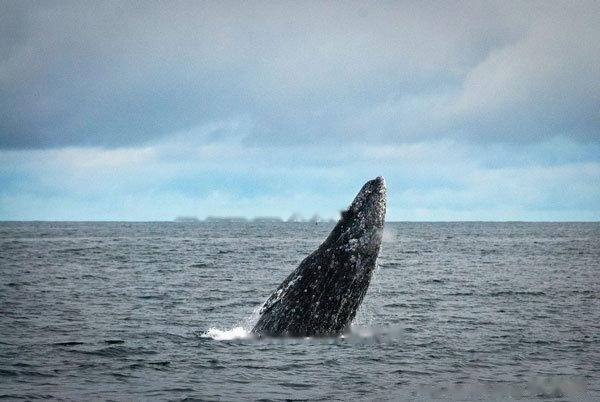
Migratory
It is the longest migratory species of mammals and can migrate up to 10000-22000 km. On the North American side of the Pacific Ocean, gray whales cross the Bering Strait and the northwestern Bering Sea from late May to late October to feed in the Arctic Circle, where water temperature and light are more suitable, and then begin to move southward through the Aleutians The archipelago, which travels south along the coast of the North American continent, averages about 185 kilometers per day. Breeds during February on the warmer, sunnier western side of the California Peninsula and the southern side of the Gulf of California. After February, it began to move north again, but the route was different from that of the south. The round-trip distance from the bait site in summer to the breeding site in winter was about more than 18,000 kilometers. On the Asian side of the Pacific Ocean, gray whales pass through the Sogo Strait from the Sea of Okhotsk into the Sea of Japan, and then along the east coast of North Korea through the South China Sea to China.
The northwestern Pacific population overwintered in the Sea of Okhotsk in summer and in the waters of Guangdong and Hainan Province in autumn; the northeastern Pacific population in the Chukchi Sea, Beaufort Sea and Bering Sea in summer, and along the coastline to Mexico in autumn Winter on the west coast of Baja California.
Food
Grey whales feed primarily on small planktonic crustaceans, herring fish eggs, and other school fish For food, they also eat sea urchins, starfish, conch, hermit crabs, prawns, sea cucumbers and seaweeds. However, when migrating southward, they do not eat food, and their stomach is empty, and they often eat food when they migrate northward.
diving
It is also a shallow dive after a few breaths, followed by a longer deep dive to a depth of about About 100 meters, the distance under water is about 1000 meters, and the duration is generally 17-18 minutes. The caudal fin does not appear above the water surface and the back is not bent during shallow dives, but it is often raised above the water surface during deep dives. Its swimming speed is very slow, generally 3-4 nautical miles per hour, and the fastest is no more than 7-8 nautical miles.
Vocals
Some gray whales particularly like to make a hum sound, about 50 times an hour, whenever and wherever, Each time lasts 2 seconds, the frequency range is between 20-200 Hz, and the intensity can reach 160 decibels, much like sighing or muttering. It's not clear why it makes this sound, some think it's echolocation or a signal of communication between group members, others think it's a natural phenomenon in response to storms, earthquakes, and recent discoveries suggest that this sound is produced. Most of the individuals who have not found a mate are those who have not found a mate, so it is speculated that this hum sound may be their sigh about lost love, or a kind of resentment and venting.
Natural enemies
The main habitat of gray whales in the ocean is killer whales, which are often attacked by killer whales, when The only way is to float on the water with the belly up, and try to avoid the disaster with the method of suspended animation.

![[Dog Training 5] The training method of pet dog dining etiquette](/static/img/12192/12192_1.jpg)