The Eastern Hermann's tortoise, also known as the Hermann's tortoise, is one of the representative species of European tortoises. They are also medium in size, making them a very popular entry breed. Mostly distributed in Eastern Europe from southern Italy to the Balkans. It belongs to the tortoise family, is omnivorous, and likes to eat legumes very much, and occasionally can prey on earthworms, snails and insects. The armor is less than 20 cm long. There is one upper buttock shield, no large warty scales on the thighs, and a total of 5-10 rows of small scales on the front edge of the forelimbs. Inhabits dry grasslands or bushy hills in areas with abundant vegetation and low humidity.
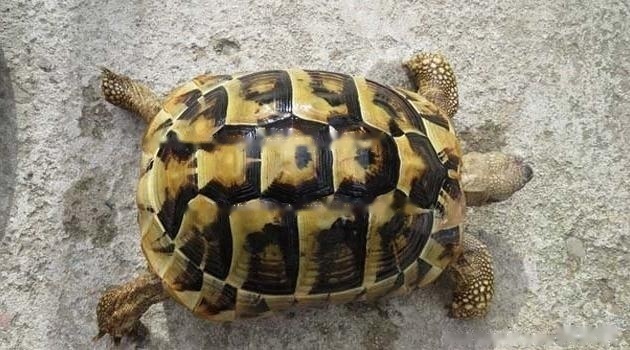
1. Physical characteristics of the Eastern Hermann's tortoise
The carapace is dark brown, with yellow stripes and many edges It is yellow; the plastron is yellow, with two dark brown spots; there are several rows of small scales on the front edge of the forelimbs, and no verrucous scales on the hind limbs. Generally speaking, there are two subspecies of Hermann's tortoises: Western Hermann is distributed in the western half of the Mediterranean from Spain to northwestern Italy; and Eastern Hermann is found in Eastern Europe from southern Italy to the Balkans. Accurately identifying the differences between the Herman subspecies is not an easy task for beginners. It is widely circulated that the western Herman has yellow scales behind the eyes while the eastern Herman does not. At the same time, the proportions of the chest shield and the thigh shield of the two plastrons are different. However, these two characteristics are not obvious in many individuals, especially It is a juvenile under 10 cm. Many people can find faint yellow scales behind their Herman eyes, but what they have is exactly that.
2. Habit characteristics of Eastern Hermann's tortoise
Hermann's tortoise is the most common entry tortoise in Europe. It is also a representative of temperate tortoises. They are distributed in the area around the Mediterranean Sea in southern Europe, so they are considered temperate tortoises, and therefore have the habit of hibernating. They hibernate in the production area from October to April of the following year, because the temperature in Taiwan is relatively high in winter. They don't really hibernate. However, the summer temperature in Taiwan is too high for temperate tortoises. Therefore, in summer, we must pay attention to measures such as shading and cooling. Generally speaking, temperate tortoises do not need to be kept warm all year round in Taiwan. Otherwise, it is easy to overheat and dehydrate and enter a state of refusal to feed and cause death.
They are very smart. The owner is quickly recognized and fixed behavior patterns and habits are quickly developed. Female tortoises of this genus are usually larger than males. Both have thorns at the tips of their tails. Lively and active, they are very good at digging holes. If they are kept in the yard, they should pay attention to anti-escape measures. Hermanns are more aggressive tortoises and it is best not to keep multiple males together. Also do not mix with other species of tortoises. Hermann's tortoises mainly eat plants but occasionally eat mollusks such as snails. Habitat in shrub grasslands, omnivorous, likes legumes.
3. Feeding of Eastern Hermann's Tortoise
【Environment】
Eastern The environmental requirements of Hermann's tortoises are nothing more than temperature and humidity. In addition, it is basking. Temperature plays an important role in western Hermann's tortoises. Mann’s tortoises are lethargic, and prolonged low temperatures can also lead to pneumonia. The required temperature does not need to be too high, and the maximum temperature should not exceed 30 degrees. Once, because the heater was turned on and the temperature control was not connected, the temperature reached 35 degrees. When the temperature was 40 degrees, the Eastern Hermann's tortoise slept for almost a day. Breeding temperatures are detrimental to western Hermann's tortoises, as excessive temperatures can easily lead to dehydration. The humidity is also not very high. In winter, when the humidity is only 20, you will not see him go to the water basin to drink water, and Xing and Myanmar will both drink a lot of water and sleep in the water. In summer, when the humidity is as high as 80, Diarrhea will appear, which proves that the eastern Hermann's tortoise is not adapted to the environment with high humidity, and the humidity of 35~50% is the most suitable.
【Feeding】
The diet of Eastern Hermann's tortoises is complex. When feeding, most of the time they eat green plants, but They will also eat some meat food. The owner can choose according to the situation, but do not feed too much meat to avoid indigestion. Under artificial conditions, it is recommended to feed dark green vegetables such as kale, mustard, vegetable core, rapeseed, etc. If you can get enough dandelion, plantain and other wild vegetables, it will be better. Flowers are also the favorite food of Hermann's tortoises. For larvae, supplements such as feed and vitamin d3 can be added to ensure that they can absorb calcium well. They love legumes and even meat, but these foods are difficult for beginners to grasp the safe dose to give, so in captivity, it is still necessary to feed a vegan, dark green, high absolute calcium content And vegetables with a calcium-to-phosphorus ratio greater than 2:1, wild vegetables and pastures.

![[Dog Training 5] The training method of pet dog dining etiquette](/static/img/12192/12192_1.jpg)