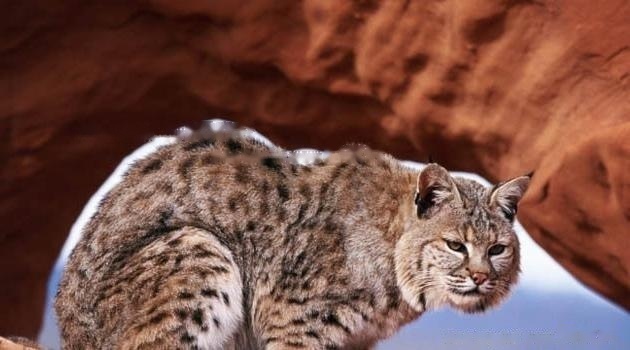
The lynx, also known as the lynx, is similar in size to a cat and is actually larger than a cat. This cat has a stout body and a short tail. Lynx is a cold-loving animal and can adapt to a variety of habitats, such as subarctic coniferous forests, cold temperate zones, alpine grasslands, and deserts. Most lynx live in scrubland and dense rocks. It likes to live alone, is good at climbing and swimming, and has a strong hunger tolerance. It can stay quietly in one place for several days without being afraid of the cold. And rodents for food!
1. Appearance characteristics of the lynx
The lynx can be described as a medium-sized beast. . Its weight is about 25 to 55kg, its body length is about 80 to 130CM, its stature is huge, and its limbs are long. The cat's tail is short and thick, with a blunt rounded tip, wide ear bases with a little black hair, and drooping hair on the cheeks. Its back is reddish-brown, its belly is yellow-white, and its coat is white around its eyes. The hair on its back is the thickest, and it has different degrees of spots or stripes attached to it, which are conducive to its predation. The color of the other back is more complex, including cream gray, tan, and khaki. Generally speaking, the tone of the rest of the body is relatively uniform, such as black or dark brown on the lips, black markings on the jaw, etc. In winter, the fur of the lynx will become more and more dense, and its claws are covered with furry hair, and it moves slowly in the snow. If you look closely, it is a bit like the effect of snow boots!
The cat's The ears stand upright, and the tips of the ears have long dark hairs, with a few strands of white hair in the middle, like the quills on the head of an actor, but it adds a bit of momentum to it, making it more powerful. Its ear shells and bristles have the function of searching for sound sources.
2. Characteristics of Lynx
1. Habitat
Lynx likes to travel alone in the vast In the space, there is no fixed nest, and it is often active at night. During the day, the cat lays lazily on the rocks to soak up the sun, and when it rains, it hides quietly under the big tree. What is unimaginable is that it can hibernate quietly in one place, and even stay motionless for a few days, and at the same time, it can run continuously for more than ten kilometers without stopping to rest. For the lynx, the activity is very frequent in the morning and twilight, but the range of activities is variable. It needs to be determined according to the abundance of food. In addition, cats have their own territory and fixed defecation points!
2 .Habits
The lynx is as cunning as a fox and is very vigilant. If it encounters danger, it will quickly jump up to the trees to hide, and sometimes even lie upright on the ground , pretending to be dead, in order to confuse the enemy, so as to avoid the enemy's pursuit. This move is really high, I have to say, the Bobcats are indeed very smart. It has many natural enemies, such as snow leopards, bears, tigers and leopards and other larger beasts. If it encounters wolves, it will be a near death and it will be difficult to escape! Usually, it will only be provoked when it is provoked. Fight back!
3. Predation
The lynx's food is mainly a variety of hares, so in some places, the number of lynx will increase with the number of hares The quantity changes with it, and secondly, it also has many food, such as squirrel, ptarmigan, voles, sheep, deer and other livestock. It can stay in one place for days and nights in order to catch food. Once a prey is approaching, it will rush out without being prepared to successfully capture the prey, and then enjoy a feast of beauty. The appearance of a prey!
3. The breeding method of lynx
March and April of the year are the mating period of the lynx and the gestation period Around two months, each litter has 2 to 4 cubs. The estrus period is in the late winter and early spring of each year. The female cat will give birth to 2 to 4 cubs. When the pups are one month old, they can eat solid food, but in the second year they are in heat. will leave the mother. When separated from their mothers, these puppies will sometimes continue to live together in order to take care of each other, and within a few months, they will go their separate ways!

![[Dog Training 5] The training method of pet dog dining etiquette](/static/img/12192/12192_1.jpg)