The adult rhinoceros beetle often inhabits trees. Good at flying, eggs grow, and larvae feed on decaying wood. The life cycle is relatively long, generally 1 to 2 years to complete one generation, and the larvae spend the winter. So what is the shape and characteristics of it? Have you ever understood it?
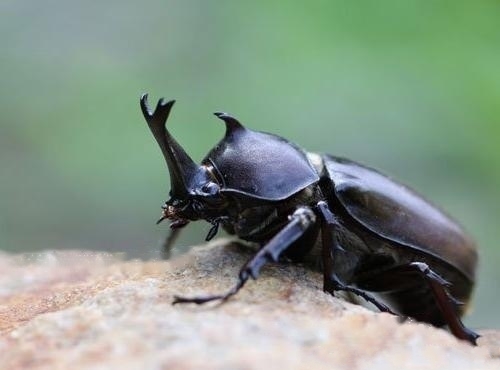
Fork rhinoceros
Males are 34-43 mm long and 19-23 mm wide. The body shape is long oval, the body color is dark brown to dark brown, and the luster is dull. The head is small, the end of the frontal horn is deeply forked into two branches, and there is a spinous process on each side of the near-middle part of the horn. Lip base deeply concave. Antennae 10, gills short. The pronotum is short, broad and clean, the longitudinal ribs are not obvious, and there are fine engravings; there is a forward thoracic dorsal angle in the center, and the ends are deeply forked. The scutellum is short and broad triangular, with a middle longitudinal groove. Elytra smooth. The buttocks are broad and nearly fusiform, smooth and strongly arched. The underside of the chest is densely covered with fluff. The feet are strong, with 3 teeth on the outer edge of the tibia of the forefoot, and two teeth at the base tooth away from the end. The females are dark and shiny. The forehead is slightly concave without protrusion, and the surface is rather rough. The end of the pronotum is densely engraved with round dots, and gradually becomes smaller toward the base; there is a early-shaped pit in the middle, the front edge of the oblate part is uplifted into a transverse ridge, and there are two small tumor protrusions in the center of the rear edge. The gluteal plate has a wide transverse groove.
The rhinoceros beetle is 3 to 8 centimeters long and 1.8 to 3.8 centimeters wide. The body is oblong, the ridges are arched, and the body is chestnut brown or dark brown. The head is small with 10 antennae. The tops of the horn-like protrusions on the male head are symmetrically bifurcated, the top of the bifurcation is almost perpendicular to the central axis of the horn-like protrusions, and the back is smooth and shiny. The female body is slightly smaller, and there are no horns on the head and chest, but there are T-shaped grooves on the pronotum and back, the central bulge of the head and the face, and there are 3 small protrusions in the horizontal row. The three pairs of long legs are powerful and powerful, with many small spines and one pair of claws at the ends, which are powerful tools for climbing.

Subscribe to Newsletter
Professional platform for pets, dogs and cats.
![[Dog Training 5] The training method of pet dog dining etiquette](/static/img/12192/12192_1.jpg)