The hot spring snake is currently a kind of non-venomous snake unique to Tibet. It is very rare. Usually, it likes to live in small rivers or rock crevices. It has a very docile temperament and usually feeds on mice, rabbits and fish. After understanding whether the hot spring snake is poisonous, let's introduce its morphological characteristics.
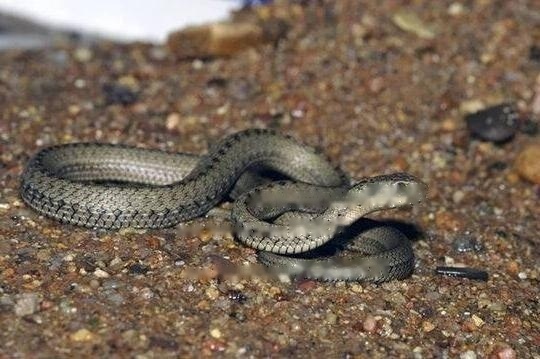
The head and neck of the hot spring snake are clearly distinguished, the back of the head is gray-green, the head and belly are light yellow, and the trunk The back of the tail is olive green with three rows of dark brown patches, the largest of which is one row. The two outer edges of the dorsal scales are gray-green, forming several fine vertical lines of alternate depths. There is a gray light stripe behind the eye from the lower retro-orbital scale, through the upper edge of the 7th and 8th upper lip scales, obliquely to the corner of the mouth, and extending backward to connect with the longitudinal stripe on the side of the body. Maxillary teeth 21-24, gradually increasing backward. The snout scales are slightly triangular, visible on the back; the pupils are rounded.

Subscribe to Newsletter
Professional platform for pets, dogs and cats.
![[Original] Sharing of popular science knowledge of ringed map turtles](/static/img/11249/11249_1.jpg)