Speaking of the Indian tortoise, many people may not have heard of its name. So today, let Xiaobian give you some popular information about it! Friends who want to know, come and have a look~
I. Basic information
Chinese name: Indian tortoise
Latin name: Indotestudo forstenii
Alias: Sulawesi Tortoise, Sulawesi Tortoise, Celebes Tortoise
Kingdom: Animalia
Phylum: Chordates
Class: Reptiles
Order: Turtles
Family: Tortoise
II. Morphological characteristics
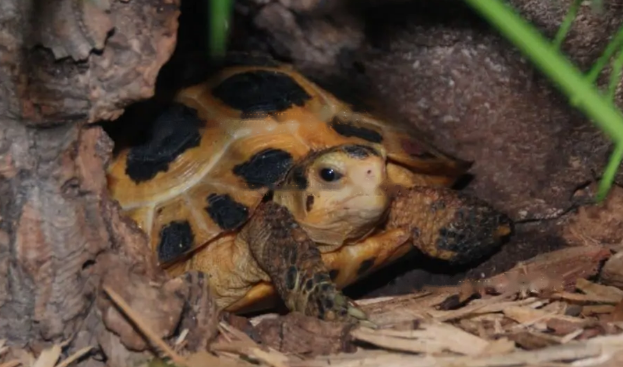
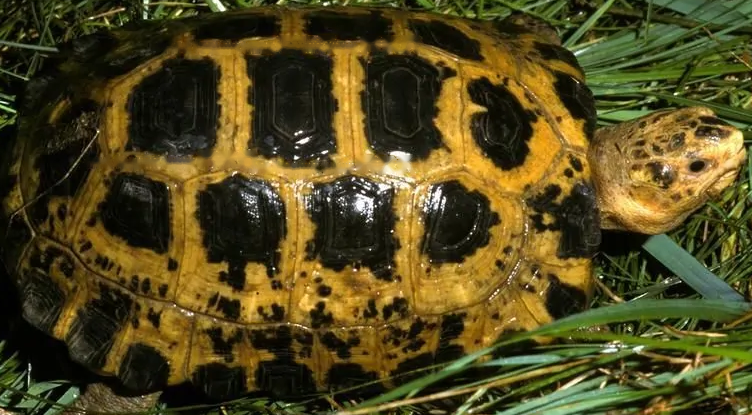
The body length of the Indian tortoise is about 15-18 cm. The carapace (oblong-shaped) is pale yellow, arched high, flat in the center, and covered with relatively uniform black (square-shaped) spots.
The plastron of the Indian tortoise is pale yellow, with a thicker front edge, scales on the top of the head and limbs, a serrated upper jaw, no neck shield, no webs between each toe, and a short tail , which is yellow.
III. Identification of males and females
1. Male tortoises are longer and female tortoises are rounder.
2. Male Indian tortoises have long and thick tails, while female Indian tortoises have short and thin tails.
3. The plastron of male Indian tortoises is concave, while the plastron of female Indian tortoises is flat.
4. The male Indian tortoise does not grow as fast as the female Indian tortoise, so the size will be slightly smaller.
IV. Distribution range
The Indian tortoise is mainly distributed in the Indonesian archipelago, Sulawesi and Halmahera. It is understood that in 1997, there were also a small amount of imported products in our country.
V. Habits
Indian tortoises like to live in tropical and subtropical rainforests because these places are warm and humid.
Indian tortoises start feeding when the temperature is above 20 degrees Celsius, and they go into aestivation when the temperature exceeds 32 degrees Celsius. When the temperature is below 15 degrees Celsius, the Indian tortoise will stop eating and enter a state of hibernation.
Six. Diet
The Indian tortoise is an omnivorous animal, mainly feeding on fresh fruits, wild vegetables and juicy leaves. They also eat insects or the carrion of other animals.
7. Breeding method
The breeding method of Indian tortoises is oviparous, and their breeding season is from November to January of the following year. During this period, the female turtle will find a place to lay eggs in advance, and will lay a nest each time, and a nest has about 1-3 eggs.
VIII. Protection level
The number of Indian tortoises is relatively rare and has been included in the United Nations List of Endangered Wildlife.
9. Common Diseases
1. Gastroenteritis: manifested as loose stools with a small amount of mucus. In severe cases, Indian tortoises will Stop eating.
2. Skin rot: The skin festers and forms a hole. In severe cases, the Indian tortoise will shrink its head and stop eating.
3. White eye disease: Indian tortoises suffering from this disease will have inflammation and congestion in the eyes, secretions will flow, and the outside of the eyeballs will be covered by secretions, resulting in the inability to open the eyes.
Today's sharing is over here~Thank you for reading, and friends who like Indian tortoises quickly bookmark this article!

![[Original] Sharing of popular science knowledge of ringed map turtles](/static/img/11249/11249_1.jpg)