The yellow-fronted box turtle is a species of turtle with a wide distribution range, in addition to China, it is also distributed in Vietnam and Laos. Today, the editor will give you some popular science information about it from five directions, let's take a look~
I. Basic information
[Chinese name] Yellow-fronted box turtle
[Latin scientific name]Cuora galbinifrons
[English name]Indochinese Box Turtle
[Another name] Hainan box turtle, yellow-fronted box Turtle
【Kingdom】Animal Kingdom
【Domain】Chordates
【Subphylum】Vertebrate Subphylum
【Class ] Reptiles
[Subclass] Turtles
[Order] Turtles
[Suborders] Turtles
【Family】Turtoidae
【Subfamily】Turtle subfamily
【Genus】Turtle genus
【Species】Yellow-fronted Shell turtle
[named by] Bourret
[named time] 1939
II. Appearance characteristics
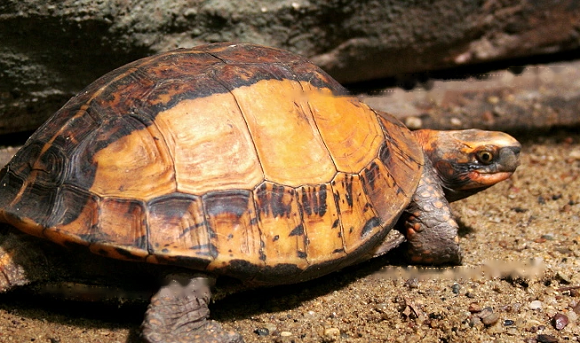
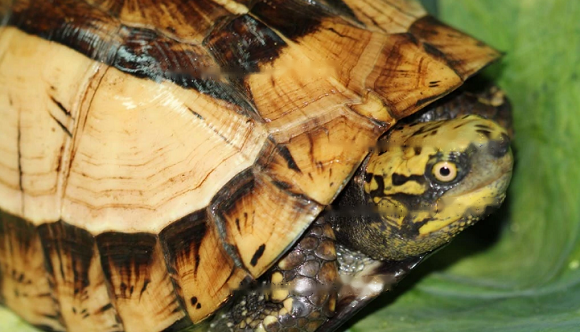
The yellow-fronted tortoise is medium in size, the middle of the carapace (the vertebral shield and the adjacent costal shield) and the periphery (the shield, the back of the marginal shield) are tan, and the sides of the carapace (except the above parts) are yellow, The carapace has a length of about 83-186 mm, a width of about 68-129 mm, and a height of about 40-92 mm. Slightly turned upward, and some are jagged.
The head is of moderate size, with a width of about 20.5-28.5 mm, about one-third of the width of the carapace, olive, light yellow or golden in color, with brown spots, and the top of the head is relatively smooth The snout slightly exceeds the upper jaw, the upper jaw is straight and has no indentation; the lower jaw is slightly shorter; the eyes are larger, the eyeball is black, the iris is orange, and there is a golden longitudinal stripe behind the eye to the tympanic membrane.
The cervical shield is relatively narrow and long; there are 5 vertebral shields, of which 1-4 or 1-3 vertebral shields are prominent in the center of the anterior edge and concave in the center of the posterior edge; there are 4 pairs of costal shields; Edge shields come in 12, 13 or 11 pairs.
The color of the plastron is tan and relatively flat, slightly shorter than the carapace, the front and rear edges are rounded and not indented, the front and rear lobes of the plastron can close the carapace upward; there is no obvious bridge, There is also no axillary shield and crotch shield; the anal shield is larger, only one, and there are no grooves or other marks on it.
The limbs are of moderate length, with large imbricate scales on them, of which the scales on the back of the forelimbs are the largest, and there are only a few large scales on the wrists and heels; the forelimbs are yellow with 5 claws, and the hind limbs are gray-brown It has 4 claws, with semi-webbed fingers and toes; the tail is short, has hard scales, and is gray or yellow in color.
III. Habits
1. Living habits
The yellow-fronted box turtle mainly lives in hills, mountains, streams and shallow water areas, and likes to hide in In the fallen leaves under the woods, it usually comes out during the day to be active.
From March to July, the yellow-fronted sea turtle generally lives by the streams in the mountains and forests; in the dry season, it will enter the hibernation period for up to 4 months; its suitable living temperature is between 24-28 The activity range in the rainy season is larger than that in the dry season.
PS: The yellow-fronted box turtle has a strong terrestrial tendency and is not good at swimming.
2. Eating habits
The yellow-fronted box turtle is an omnivorous animal, mainly eating some insects, fish, shrimp and fruits.
3. Breeding method
The breeding period of the yellow-fronted sea turtle is from June to October every year, and the breeding method is oviparous, and the female turtle can produce 1-3 turtles each time. oblong white eggs (about 3 cm in diameter, about 6 cm long, and weighs about 12 grams).
4. Discrimination between males and females
1. Carapace: The carapace of female tortoises is wider, on the contrary, the carapace of male tortoises is narrower.
2. Tail: Female turtles have shorter tails, whereas male turtles have longer tails.
3. The distance between the cloacal hole and the plastron: the cloacal hole of the female turtle is closer to the rear edge of the plastron, while the cloacal hole of the male turtle is farther from the rear edge of the plastron.
V. Status of conservation
Due to human hunting and destruction of living environment, the number of yellow-fronted sea turtles is gradually decreasing and has been recorded In a number of protected lists, the details are as follows:
1. World Conservation Union Red List of Threatened Species (IUCN 2015), it is critically endangered.
2. Convention on International Trade in Endangered Species of Wild Fauna and Flora (CITES Appendix II).
3. China's Biodiversity Red List - Vertebrate Volume (Reptiles).
4. The List of Terrestrial Wild Animals Protected by the State that is Beneficial or Has Important Economic and Scientific Research Value issued by the State Forestry Administration of China on August 1, 2000.
5. Red Book of Endangered Animals in China, which is critically endangered.
6. The List of National Key Protected Aquatic Wild Animals Revised by the Ministry of Agriculture in 2000, which is a second-class protected animal.
Well, the introduction to the yellow-fronted box turtle, the editor will stop here. If you want to know more about other turtles, please continue to pay attention to this site.

![[Original] Sharing of popular science knowledge of ringed map turtles](/static/img/11249/11249_1.jpg)