There are four subspecies of snapping turtles: Florida snapping turtle, Central American snapping turtle, North American snapping turtle and South American snapping turtle. Among them, the North American snapping turtles are larger, and the South American snapping turtles are relatively small. Today, what the editor wants to talk about is the very miniature South American snapping turtle.

South American snapping turtles The snapping turtle gets its name from the fact that it lives in South America. It is a very rare species in the snapping turtle market. It is basically invisible in China, so everyone is very curious about it. Next, let's talk about its related information in detail. If you are interested, you can collect it and follow it.
I. Basic information
[Chinese name]South American snapping turtle
[English name]Chelydra acutirostris
[Life]: 50-60 years
[Distribution]: Mainly distributed in northern Honduras, eastern Nicaragua, to Costa Rica, Panama, across the Pacific Ocean to Colombia and Ecuador, south to Eyaquil Gulf
[Classification]: Animalia, Chordates, Vertebrates, Reptiles, Turtles, Turtles, Suborders
[Populations]: Ecuadorian population, Nicaragua population
II. Morphological characteristics
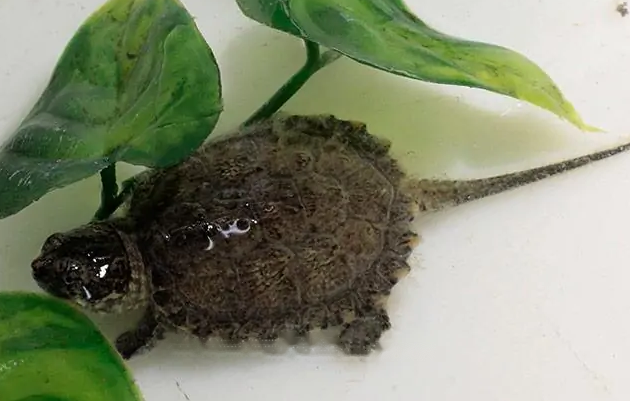
1. Body size: South American snapping turtle is about 20-30cm, and the maximum can reach 41cm. The head is broad, the tip of the nose is slightly raised, the eye lines are obvious, the beard is thick, and it looks like a toad.
2. Carapace: The carapace is slender, without obvious radial lines, raised like small particles, almost round, the older the carapace, the flatter the carapace will be.
3. Abdomen: There are worm patterns, similar to those in China and the United States. There are many spines on the body, especially the wart grains are more obvious.
4. Body color: relatively bright, juveniles show red, orange, yellow and other colors. The carapace is olive brown, dark brown, olive gray or black, while the plastron is yellow, tawny or gray.
III. Living habits
1. Habitat environment: South American snapping turtles are aquatic turtles with good adaptability to water. Inhabits ponds, lakes, swamps, quagmire, etc., and occasionally in some rivers.
2. Eating habits: South American snapping turtles are omnivores, larvae will eat some small fish, shrimp, mealworms, etc., and adults will eat small animals in the water or on the shore.
3. Living temperature: The suitable temperature for the snapping turtle in South America is 22~28℃, which is the best temperature for its activities, foraging and growth. Generally, the temperature is 15-17 ℃, and there will be a small amount of activity. Above 10 ℃, it can overwinter normally, below 12 ℃, it will enter a light hibernation state, and it will enter a deep hibernation state at 6 ℃.
4. Reproduction: oviparous. Mating from April to September every year, spawning period from May to November. There are usually 20-30 eggs per clutch. The eggs are white, spherical, slightly rough in appearance, generally 23-33mm in diameter, and weigh 7-15g.
The above is the All about the introduction of the South American snapping turtle, I have to say, the South American snapping turtle is still very distinctive, what do you think?

![[Original] Sharing of popular science knowledge of ringed map turtles](/static/img/11249/11249_1.jpg)