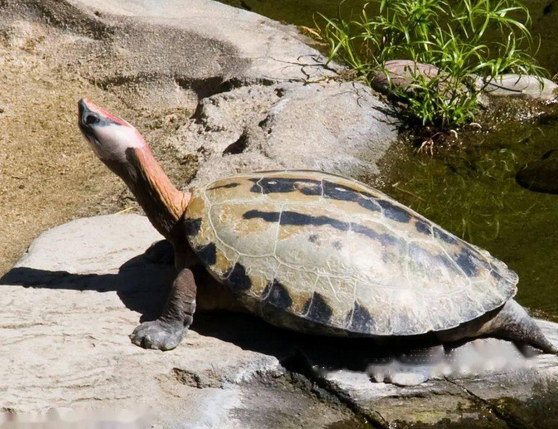
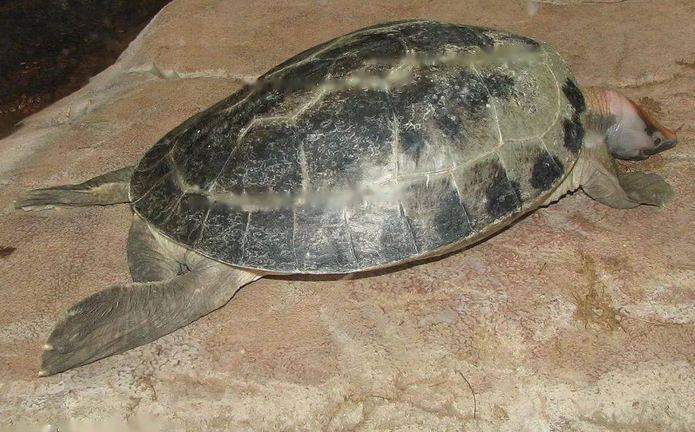
As the name suggests, the turtle's carapace pattern looks like a watermelon rind from a distance, so it is also called a watermelon turtle.
Because of its unique pattern, it has attracted the attention of many turtle lovers, and many people want to raise a salty cement painted turtle at home. But it is a pity that they have been listed as endangered species and cannot be kept by individuals! Friends who are interested in them can take a look at the popular science introduction of salty cement colored turtles shared by the editor below.
1. Basic information
English name: Painted Terrapin, Painted Batagur
Latin name: Batagur borneoensis
Alternative name: mud turtle, three-line turtle , Watermelon Turtle
Family: Freshwater Turtles
Genus: Saltwater Turtles
Named and Date: Schlegel & Müller, 1844
Distribution range: mainly distributed in Brunei, Indonesia, Malaysia, Thailand
Protection level: included in the World Conservation Union Red List of Threatened Species (IUCN2000 ver 3.1) - Critically Endangered ( CR); listed in the Convention on International Trade in Endangered Species of Wild Fauna and Flora (CITES) - Appendix II.
2. Morphological characteristics
1. Body size: The body size is large, the adult salty cement turtle weighs more than 2.5 kg, and the carapace length can reach 70 cm or more.
2. Carapace: The carapace is gray-brown, oval in shape, wide in the front and narrow in the back, slightly raised in the middle, and there are large irregular black spots on the scutellum of the carapace.
3. Plastron: The plastron is light yellow, narrow but long; the bridge is also light yellow and wider.
4. Head: The eye socket and face are black; the snout is upturned, also black; the neck is brownish gray.
5. Limbs: Limbs are gray-brown or light yellow with scales.
6. Differences between males and females: The head of the female salty cement turtle is charcoal gray; the top of the head of the male is charcoal gray when young, and the side of the top of the head gradually turns white at the age of reproduction.
III. Living habits
1. Living environment
The salty cement turtle belongs to the water sacrificial turtle class. Young turtles live in freshwater rivers. They like warm and cold, and the suitable growth temperature is 18-30 degrees Celsius. If they are lower than 11 degrees Celsius, they will enter a state of hibernation. However, during hibernation, if the ambient temperature is lower than 5 degrees Celsius, they can easily die.
2. Eating habits
The salty cement turtle is an omnivorous turtle, and usually likes to eat small fish, snails, saltwater fish, sea and plant stems and leaves.
Four. Breeding methods
The breeding season of salty cement turtles is generally from June to August, when the temperature is between 20-28 degrees Celsius , When the water temperature is between 16-25 degrees Celsius, the salty cement turtles will mate. Female turtles lay their eggs in self-dug caves on the shore, and each lays up to 12 eggs. Egg white, hard shell. Eggs have a long diameter of 68-76 mm and a short diameter of 36-44 mm.
Okay , the above is all about the introduction of salted cement turtles, if you want to know more information, please continue to pay attention to this site~

![[Original] Sharing of popular science knowledge of ringed map turtles](/static/img/11249/11249_1.jpg)