Badakur turtle is a relatively large freshwater turtle species. I believe that many friends do not know much about it. Then, the editor will lead you into the world of Badakur turtle. Look~
I. Basic information
Chinese name: tide turtle
Latin name: Batagur baska
Alternative name: Badaku Eared tortoise, giant river tortoise, tortoise tortoise, royal tortoise
Kingdom: Animalia
Phylum: Chordate
Subphylum: Vertebrate subphylum
Class: Reptiles
Subclass: Turtles
Order: Turtles
Family: Turtles
Named and dated: Gray, 1830
2. Morphological characteristics
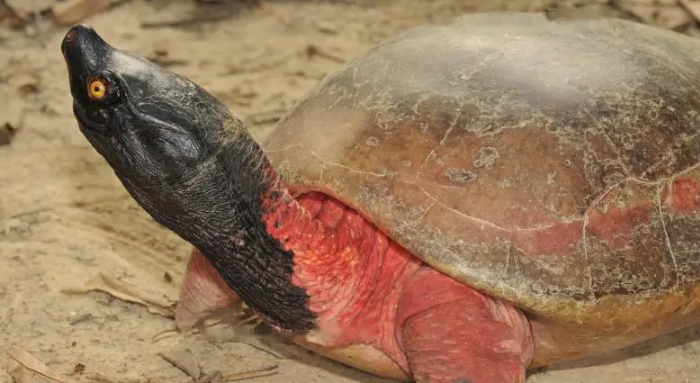
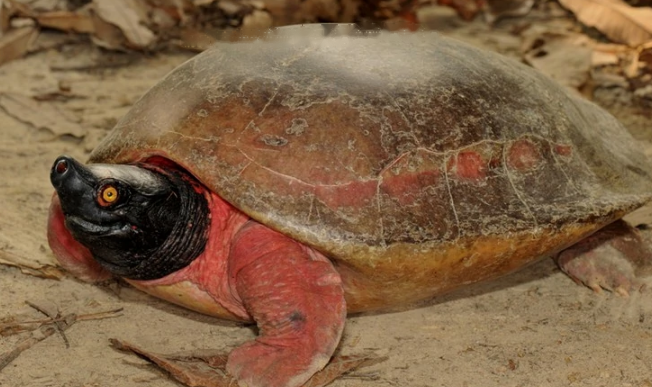
1. The head of an adult Badakur turtle The snout is small, the tip of the nose is upturned, the carapace (without plaque, oval) is gray-black, the surface of the carapace is relatively smooth and without edges, and the rear edge of the carapace is not serrated.
2. The carapace of the juvenile Badakur tortoise is as smooth and edgeless as the adult, but the juvenile has a more pronounced central ridge, and the carapace is round, brownish-gray or olive-colored .
3. The plastron of the Badakur turtle is light yellow, the bridge is relatively wide, and the transition to the plastron forms edges and corners. Its laryngeal shield is more characteristic, it is very short in the longitudinal direction, but it is almost as wide as other abdominal shields in the transverse direction.
4. The head and limbs of the Badakur turtle are gray-black, with webs between the fingers and toes, and 4 claws on the forelimbs.
III. Discrimination of male and female
The female Badakkur tortoise is larger in size, has a shorter tail, and the cloaca is closer to the rear edge of the carapace; male Badakur tortoises are smaller, with a thicker and longer tail base, and a cloaca closer to the rear edge of the carapace.
IV. Distribution range
It is known that Badakur tortoises were widely distributed in Central Asia and Southeast Asia. However, they may exist in Bangladesh and India at present, and may exist in Myanmar. Extinct, extinct in Thailand.
V. Habits
1. When the ambient temperature is 18 degrees Celsius, Badakul tortoises can eat normally; when the temperature is 15 degrees Celsius, Badakuer turtles will eat less or stop eating; when the temperature is 10-12 degrees Celsius, Badakuer turtles will enter a state of hibernation.
2. When they were young, they were meat-eating turtles, mainly feeding on fish, crustaceans, shellfish, etc.; Feed on leaves, stems, and fruits.
Six. Breeding method
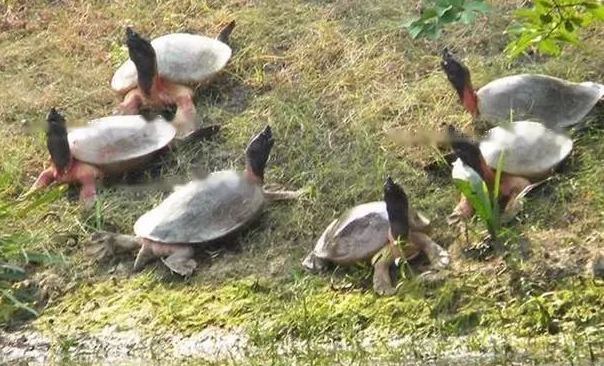
The breeding season of the Badakur turtle is autumn, and the breeding method is oviparous. During the spawning period, the female Badakur turtle will swim upstream and lay her eggs on undisturbed dunes or beaches.
Female Badakul tortoises can lay 13-34 eggs each time, each egg has a long diameter of about 66-70 mm, a short diameter of about 45 mm, and an incubation period of about 70-112 sky.
VII. Status of the race
Because of the constant hunting and killing, the large number of eggs being mined (unable to hatch to supplement the number of races) and the destruction of the living environment, the Badakur tortoise's The number is gradually decreasing, and the distribution area is also shrinking. It is now included in the World Conservation Union Red List of Threatened Species (IUCN 2018 ver 3.1) - Critically Endangered (CR) and Endangered Wildlife Convention on International Trade in Plant Species (CITES) - in Appendix I.
The above is all the relevant information of the Badakur turtle~ If you have any questions, please leave a message in the comment area~

![[Original] Sharing of popular science knowledge of ringed map turtles](/static/img/11249/11249_1.jpg)