Many smart turtle friends can often guess some characteristics of turtles based on the turtle's name (although they have not seen it), such as turtle shape, origin, etc. But today, the turtle that the editor is going to talk about can't guess its information just by looking at its name. So what exactly is holy?
Hahaha~ It is one of the five species of the Oriental Tortoise, the sugarcane forest turtle. It does not look like sugarcane, nor does it live in sugarcane forests. So what are its characteristics? Let’s talk about it in detail from five aspects! Please look down~

I. Basic information
[Chinese name] Cane forest turtle
[Latin name] Heosemys silvatica
【English name】Cochin Forest Cane Turtle
【Kingdom】Animal Kingdom
【Domain】Chordates
【Class】Reptiles
[Order] Turtles
[Suborder] Suborder Turtles
[Family] Turtles
[Subfamily] Earth Turtle subfamily
[genus] oriental turtle
[species] cane forest turtle
[main distribution] southern India
II. Appearance characteristics
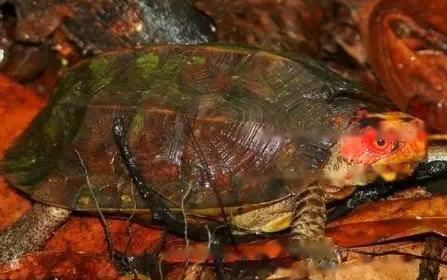
The head of the cane forest turtle is medium in size; the main color of the head and neck surface is brown and black; Scales, polygonal; the snout is short, slightly beyond the lower jaw, and mixed with some red patches; the upper jaw is hooked; the iris is red.
The color of the carapace is bronze, oval in shape, and slightly raised; there are three protruding ridges on the carapace, and the central ridge is more obvious.
The color of the plastron is orange, with a black spot on the chest shield and the ventral shield; the color of the limbs and tail are light brown; the fingers and toes are webbed; Less pronounced jaggedness.

III. Living habits
1. Habitat environment
The sugarcane forest turtle is a semi-aquatic turtle, mainly living in dense trees above 300 meters above sea level In hilly areas, they do not like to stay in water and generally live in underground burrows.
2. Eating habits
Although the cane forest turtle is omnivorous, it prefers plant food, such as leaves and fruits, and occasionally eats some insects and snails.
3. Breeding method
The breeding method of the cane forest turtle is oviparous, and the breeding time is usually in June and September-November each year. The female turtle lays eggs in January-February of the following year, and can lay 1-2 broods per year, with each brood producing about 2 eggs.
4. Discrimination between males and females
The method to distinguish males and females of cane forest turtles is very simple, which can be distinguished from the body shape and tail.
1. Body size: Compared with the same age, female turtles are generally larger than male turtles.
2. Tail: The tail of male turtles is longer and thicker than that of females.
V. Protection level
Due to the scarcity of sugarcane tortoises, they are very cherished and have been recorded in several protection lists, as follows:
1. The Washington Convention (Appendix II to CITES).
2. International Union for Conservation of Nature Red List of Threatened Species (IUCN), endangered.
Well, the introduction of the cane forest turtle, the editor will stop here! Guys, do you understand? If you have any questions, please leave a message in the comment section~

![[Original] Sharing of popular science knowledge of ringed map turtles](/static/img/11249/11249_1.jpg)