Speaking of the giant ring sea snake, many people may not have heard of its name. So today, let me share with you some information about it! Friends who want to know, come and have a look~
I. Basic information
Chinese name: Giant Ring Sea Snake
Latin name: Laticauda colubrina
Kingdom: Animalia
Phylum: Chordate
Subphylum: Vertebrate subphylum
Class: Reptiles
Order: Squamata
Suborder: Snakes
Family: Cobras
II. Appearance characteristics
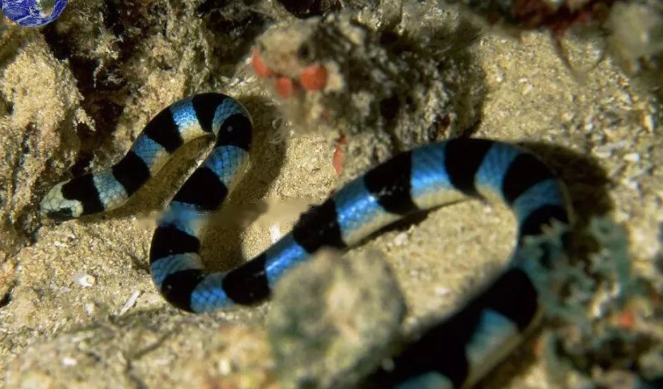
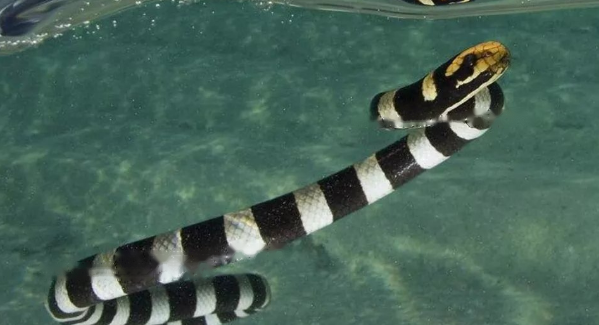
Comparatively speaking, the giant ringed sea snake is very large, and its body length is generally about 2 meters. It is understood that some individuals can even exceed 3 meters. The body surface of the giant ringed sea snake is circular black and white stripes, the head looks relatively flat and round, and the tail is relatively flat, like a boat oar.
III. Distribution range
The giant-ringed sea snake has a wide distribution range, including the coastal areas of China, Japan, Indonesia, Fiji, Sabah, and the Philippines. area.
4. Living habits
1. Giant-ringed sea snakes concentrate their activities at dusk and at night, because this time is favorable for them to hunt in water. Occasionally, they also appear in sun and shade to regulate their own temperature.
2. Because the nostrils are located at the top of the nose, the giant ringed sea snake does not need to expose its entire head to the water to breathe. They also have strong lung capacity and can usually stay in the water for more than an hour. However, despite this, they are accustomed to surfacing every 5 to 20 minutes for a breath.
3. The giant ringed sea snake has the habit of expelling salt from the body. They have a salt gland at the bottom of their tongue sheath that collects the salt that enters their body, which they then expel by moving their tongue.
5. Eating
The giant ringed sea snake mainly feeds on fish; when preying, they will use their fangs to inject venom into the prey, so that the whole body of the prey will be damaged. Paralyzed, unable to move. Giant ringed sea snakes can also swallow food wider than their own head, and they can completely digest the entire prey (including bones).
6. Reproduction method
The giant ringed sea snake can reproduce all year round, and the reproduction method is oviparous. Female giant ringed sea snakes have certain requirements for spawning environment. They often choose to lay eggs in coral reef areas, and can lay up to 20 eggs at a time. After laying eggs, the female giant ringed sea snake will allow the snake eggs to hatch on their own. The well-developed young snakes can reach sexual maturity in just one and a half years.
Seven. Status of Race
Because the giant ringed sea snake has a wide distribution range and a large number, many humans hunt and kill them, resulting in a large number of sea snakes. somewhat reduced. Now, the giant-ringed sea snake has been included in the List of Terrestrial Wild Animals Protected by the State that are Beneficial or Have Important Economic and Scientific Research Value.
The above is the introduction about the giant ring sea snake, do you understand?

![[Original] Sharing of popular science knowledge of ringed map turtles](/static/img/11249/11249_1.jpg)