Speaking of the giant pit viper, many people may not necessarily know it. This is the largest poisonous snake in South America. Even the king cobra can't beat it, and it is avoided. This venomous snake is mainly distributed in the forests and scrublands of the Amazon River Basin north to Costa Rica. on the first place. Let me introduce you to the specific information about this guy:I. Morphological characteristics
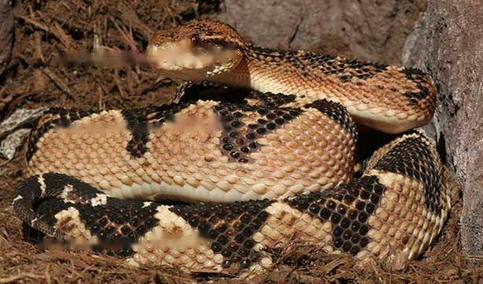
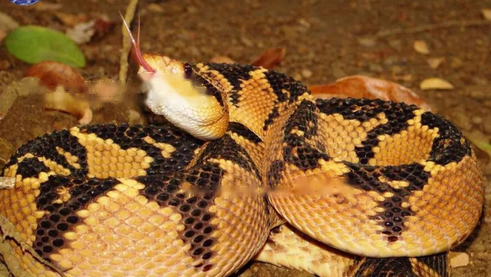
The head of the giant pit viper is slightly long triangular, the back is gray-brown to brown, and the back of the head has a deep Color ∧ shaped spots, with black spots all over the body. There are large symmetrical scales on the back of the head, cheek sockets in front of the eyes, and two longitudinal round spots on the back of the body.
Its body color changes greatly, the back of the head and body will be gray-brown or earthy red, the head has a black band from the back of the eyes to the corner of the mouth, and there is a yellow-white fine line on the upper edge; the back of the body is alternately arranged with black and brown round spots ; ventral surface gray-white to gray-black brown, with irregular black spots; tail tip is black.
2. Living habits
The giant pit viper likes to linger among fallen leaves or dead trees. In order to ambush their prey, they may linger in one place for several weeks. They are very patient hunters. Whenever they catch prey, they will start to devour bit by bit from the head of the prey. For those aggressive or particularly large prey, they will not have hard steel, they will bite the prey first, and then eat it. Let go and wait for the venom to erode.
Giant pit vips are oviparous animals and can lay 5-18 eggs at a time. Female giant pit vipers are very dangerous after laying eggs. They will attack all moving objects and have a strong desire to protect, so do not approach them at will.
Three, living environment
Giant pit vips under normal circumstances, like to inhabit rock piles, grasses and bushes, and occasionally encounter giant pit vipers entrenched in old caves, these are frogs, rats, etc. drilled.
The last thing I want to say is that the giant pit viper locks its prey with its hot cheek sockets, so it has phototaxis. Sometimes tourists or natives light a bonfire. If the giant pit viper is hunting, it will crawl in the direction of the fire. . If you find a giant pit viper crawling over, you'd better put out the bonfire immediately, otherwise, this guy will follow like an African rhino, and there will be very dire consequences.

![[Original] Sharing of popular science knowledge of ringed map turtles](/static/img/11249/11249_1.jpg)