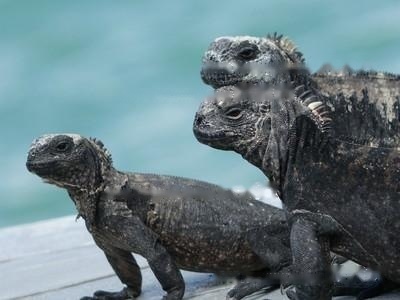
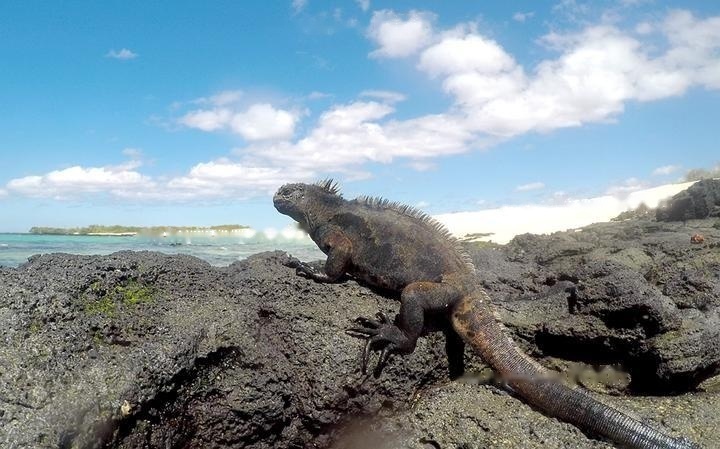
Marine iguana is a species of lizard that exists only in the Colon Islands off the coast of Ecuador in the eastern central Pacific Ocean. It is divided into 7 subspecies. The average body length of adult male marine iguanas is 0.75 meters, and the average body length of females is 0.6 meters. about 12 kg. The peculiar-looking marine iguana is the prototype of the movie Godzilla. Let me briefly introduce the popular science knowledge of marine iguanas to everyone!
I. Basic information
[Chinese name]Marine iguana
[Alias] Fernandina marine iguana, Gala Pagos marine iguana, blunt-nosed lizard
【Latin name】Amblyrhynchus cristatus
【English name】Fernandina Marine Iguana, Sea Iguana, Galápagos Marine Iguana
【Kingdom】Animal Kingdom
【Domain】Chordates
【Subphylum】Vertebrate Subphylum
【Class】Reptiles
【Order】Lizards
【Suborder】Iguana
【Family】American Iguana
【Genus】Marine iguanas Genus
[Species] Marine iguana
2. Morphological characteristics
1. Body type: There are 7 marine iguanas in the Colon Islands. subspecies. The body of this reptile is relatively long, the longest can reach more than 150 cm. The ones on Fernandina and Isabela are the largest, while the ones on Genovesa are the smallest. On land, marine iguanas are clumsy, but they are nimble in the water, swimming with strong tails. The claws of marine iguanas are long and sharp, so that they can not only cling firmly to the rocks on the shore and not be swept away by the big waves, but also crawl firmly on the seabed with large currents in search of food. The tail of a marine iguana is almost twice as long as its torso. The long tail can provide enough power when swimming.
2. Body color: The whole body of the marine iguana is dark gray. However, the body color of a courting marine iguana will change from grey to black, and it will develop red spots on its body.
III. Living habits
1. Distribution: Marine iguanas only exist in the Colon Islands, which belong to Ecuador and are located in the Pacific Ocean, 1000 kilometers west of the South American continent.
2. Diet: Marine iguanas often look for seagrass and crustaceans washed up on the beach by the sea along the coastline of the island. The various mollusks attached to the reefs by the sea are also delicious for marine iguanas. Marine iguanas also often go to sea to hunt for food.
3. Vigilance: Marine iguanas respond to the effects of humans and exotic animals. When the marine iguana regards human pursuit as a danger, its plasma The corticosteroid concentration will increase within a few minutes. The intensity of a marine iguana's response to a potential hazard correlated with whether or not it had experienced a hazardous event. Those marine iguanas that had not experienced a predator threat were relaxed about approaching humans, leaving only when they were 1 to 2 meters away. During this process, their stress hormones did not change much. And among those marine iguanas who felt a moderate risk of predation, corticosterone levels in the marine iguanas only increased when the predator attacked.
4. Sunbathing: Marine iguanas are highly dependent on sunlight because they often seek food in icy waters; their dark skin helps absorb heat. Due to the cold wave area around the Colon Islands, marine iguanas must first sunbathe to obtain a higher body temperature before diving into the sea for food in a short time. After landing, you still need to increase your body temperature by sunbathing.
The above is some little knowledge about marine iguanas. You are welcome to leave a message and discuss below. If you want to know more, you can continue to pay attention to this site~

![[Original] Sharing of popular science knowledge of ringed map turtles](/static/img/11249/11249_1.jpg)