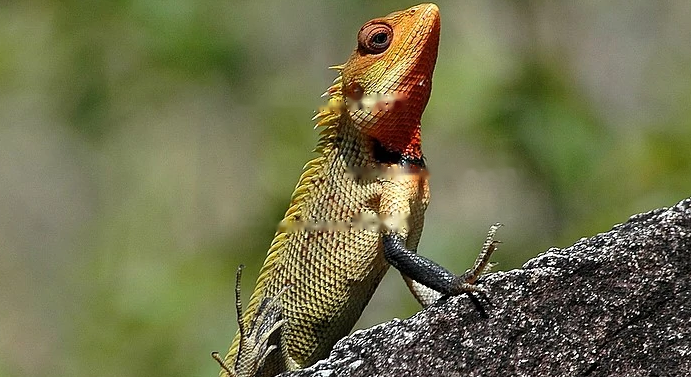
Today, I would like to introduce to you the chameleon tree lizard in the lizard family. It moves very fast, and when it encounters danger, it can jump down from a tree four or five meters high, and immediately burrow into the grass to escape. Then, let's take a look at its details~
I. Basic information
【Chinese name】chameleon
【Latin name】 Calotes versicolor
[English name]Oriental Garden Lizard
[Another name] Horsehair snake, Cockscomb snake, Four-legged snake
[Kingdom] Animal Kingdom
【phylum】Chordates
【Subphylum】Chordates
【Class】Reptiles
【Order】Squamata
【Suborder】Lizardia
【Family】Iguanidae
【Genus】Arena
【Species】 Chameleon
[Subspecies] Chameleon black-throated subspecies and Chameleon named subspecies
[Named by] Daudin
[Named time ] 1802
II. Main distribution
The chameleon tree lizard is mainly distributed in Afghanistan, Nepal, Bhutan, India, Sri Lanka, Thailand, Vietnam and China (Yunnan, Guangdong, Guangxi, Hong Kong, Hainan) and other places, and were later introduced to the Sultanate of Oman, Kenya, Singapore and the United States.
III. Appearance characteristics
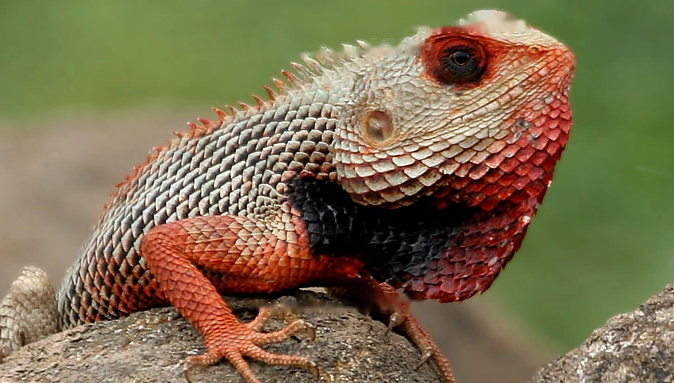
The chameleon tree lizard is relatively flat, with a slightly triangular trunk section; the snout is round; the back is light brown or gray, And mixed with some black-brown horizontal dots or short lines; 6-8 black radial lines around the eye socket; the abdomen is light white with black or dark-brown stripes. Juveniles and females will have two yellow dorsal lateral stripes with alternating dark and light rings on the tail.
PS: The color of the chameleon tree lizard can vary in shades depending on the dryness and humidity of the environment and the intensity of light.
IV. Habits
1. Habitat
Chromic tree lizards generally live in tropical and subtropical areas at an altitude of about 80-2000 meters, and usually appear in Woods, grass, riverside and roadside, etc., sometimes appear near the house.
2. Eating habits
The chameleon tree lizard mainly eats some locusts, ants, dragonflies, mantises, butterflies, crickets and some insect larvae.
3. Reproduction
The reproduction method of the chameleon is oviparous. The female lizards lay eggs from late April to September each year. They can produce 6-20 yellow-white or pale yellow oval eggs each time. The eggs hatch in about 6-7 weeks.
V. Conservation Status
The chameleon is a protected animal and has been listed in several lists, as follows:
1. The List of Terrestrial Wild Animals Protected by the State that is Beneficial or Has Important Economic and Scientific Research Value issued by the State Forestry Administration of China on August 1, 2000.
2. China's Biodiversity Red List - Vertebrate Volume, which is classified as Least Concern.
Well, the introduction of the chameleon tree lizard, the editor will stop here! Do you guys understand?

![[Original] Sharing of popular science knowledge of ringed map turtles](/static/img/11249/11249_1.jpg)