The blue rock iguana is a relatively large lizard species. I believe many friends don't know much about it, right? Then, let me tell you a little bit about it!
I. Basic information
Chinese name: Blue Rock Iguana
Alias: Cayman Island Ground Iguana lizard, Grand Cayman blue iguana, Grand Cayman iguana
Latin name: Cyclura lewisi
Binary name: Cyclura lewisi
Phylum: chordate Door
Class: Reptiles
Order: Squamata
Family: American Iguana
Genus: Rock iguana
Species: Blue rock iguana
II. Appearance characteristics
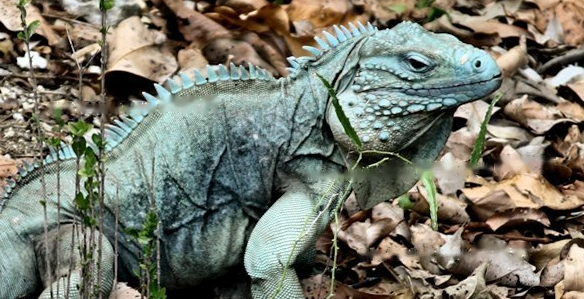
Blue rock iguana The total length can reach 2 meters and the weight can reach 14 kilograms. Adult males have dark grey to blue-green skin, females are olive green to pale blue; juveniles are dark brown or green with some darker markings; newborn juveniles have crest from neck to rump There are eight dark gabled markings that fade as the lizards age.
III. Male and female discrimination
Male blue rock iguanas are one-third larger than female blue rock iguanas; male blue rock iguanas are The color of their bodies will be more pronounced, and their feet will be black to contrast with their bodies; male blue iguanas have nodules on their thighs, while females do not.
4. Distribution range
Blue rock iguanas are mainly distributed in the West Indies countries in the Caribbean Sea, such as Cuba, Dominica, Haiti, Bahamas, Jamaica and the British Turks and Caicos Islands.
V. Living habits
The habitat of the blue rock iguana is close to the equator, where the sun is strong all year round. Therefore, blue rock iguanas are highly adaptable to temperature, and can tolerate temperatures as high as 49 degrees Celsius and as low as 10 degrees Celsius.
Blue iguanas eat primarily plant foods, such as plant seeds and flowers and fruits.
Six. Breeding methods
The breeding season of blue rock iguanas is in late May and mid-June every year; female blue rock iguanas can 1-22 eggs are laid, and the incubation period for each egg is approximately 65-100 days.
VII. Conservation level
The blue rock iguana has been included in the list of the International Union for Conservation of Nature as a critically endangered level.
That's all there is to know about blue rock iguanas! Thank you for reading, if there is anything you don't understand, please leave a message below~

![[Original] Sharing of popular science knowledge of ringed map turtles](/static/img/11249/11249_1.jpg)