The proboscis monkey, also known as the tengu monkey, is a primate endemic to Kalimantan in Southeast Asia. Today let's get to know the proboscis monkey with a super long nose!
[Chinese name] Proboscis monkey
[Another name] Tengu monkey
[Latin scientific name] Nasalis larvatus
[World] Animalia
【phylum】Chordates
【Subphylum】Vertebrate subphylum
【Class】Mammalia
【 Subclass: subclass of eutheria
[order] primates
[suborder] suborder simian
[family] monkey family
[Subfamily] Colobus subfamily
[Genus] Proboscis
[Species] Proboscis
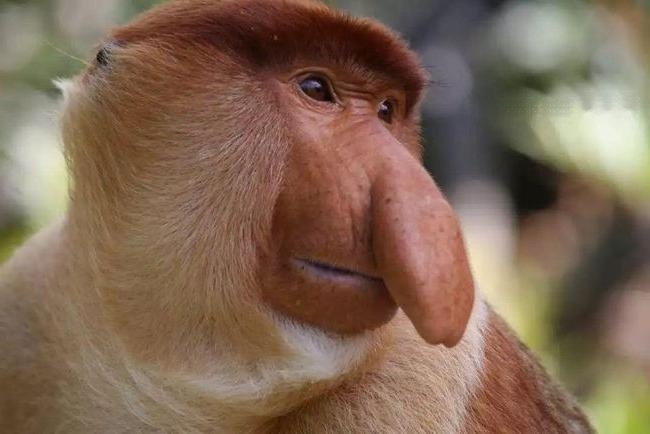
1. Body type: proboscis Monkeys weigh 7 to 22 kilograms and are 60 to 70 centimeters long. Male monkeys are much larger than female monkeys, generally 72 centimeters long, 78 centimeters long tail, and weigh 24 kilograms, while female monkeys are only 60 centimeters long. The proboscis monkey has a large abdomen, and its digestive system is divided into several parts that help it digest leaves. Hands and feet have 5 fingers, toes, with flat nails, can stand upright.
2. Body Color: The fur of the adult proboscis monkey is pink and brown; the head and shoulders are red; the arms, legs and tail are gray. Males have black scrotum and red penis. Baby proboscis monkeys are born with a blue face that turns dark gray at 2 to 3 months. At 8-9 months, it is the same color as the adult monkey.
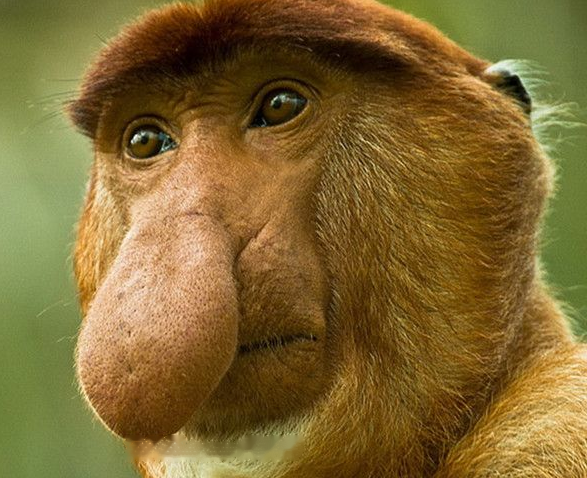
3. Notable features: The biggest difference between the proboscis monkey and other monkeys is that the nose of the adult male grows bigger and bigger with age, and the final length reaches 7-8 cm. , because of its reddish color, from a distance, it looks like an eggplant-shaped red balloon hanging on its face. Since this big nose hangs all the way to the front of the mouth and sways, it has to be tilted to one side when eating.
1. Distribution: Proboscis monkeys are distributed in Borneo, Southeast Asia, namely Brunei, Kalimantan in Indonesia, Sarawak and Sarawak in Malaysia. Sabah.
2. Social characteristics: Proboscis monkeys live a group life and have a strict community system, and each typical social group will have an adult male as the leader, and 1 to 8 monkeys. Adult females and their offspring are composed together, usually ranging from 10 to 30, and live together every day.
3. Diet: Proboscis monkeys mainly feed on seeds, mangrove buds and young leaves, and a small amount of fruits, and sometimes eat some invertebrates such as caterpillars and larvae.
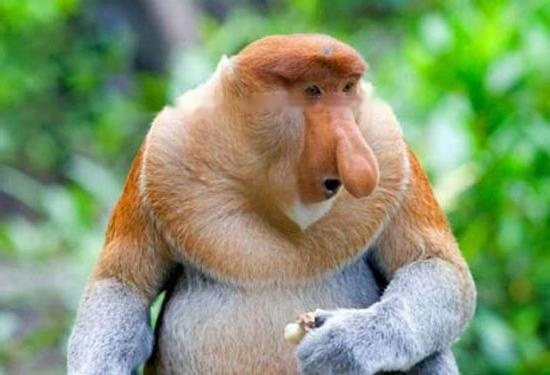
Proboscis monkeys breed once a year. During the breeding season, males mainly rely on their huge noses to please females. The gestation period of female animals is about 166 days, and each litter produces only one cub. The shape of the juvenile is very different from the adult individual. The coat of the juvenile is black and very sparse. After half a year, it is gradually replaced by ochre-yellow body hair. After 7 months, weaning, independent after 12 months, 7 years Post sexual maturity.
In Sarawak and Sabah, extensive logging of coastal mangroves and other forests has severely damaged the few remaining habitats of proboscis monkeys land. In some areas, especially in Sarawak, although the proboscis monkey is strictly protected by law, illegal hunting for recreational purposes is still a serious threat to its endangerment. At present, the proboscis monkey has been included in the World Conservation Union (IUCN) 2000 Red List of Threatened Species ver 3.1 - Endangered (EN).
The above is some little knowledge about proboscis monkeys. If you have any curious questions, you can leave a message below to discuss!

![[Original] Sharing of popular science knowledge of ringed map turtles](/static/img/11249/11249_1.jpg)