I. Basic information
Chinese name: Bell Mountain green monkey
Latin name: Chlorocebus djamdjamensis
Alternative name: Green monkey Bear Mountain Subspecies
Kingdom: Animalia
Phylum: Chordate
Subphylum: Vertebrate Subphylum
Class: Mammalia
Order: Primates
Family: Monkeyidae
Genus: Green Monkey
Species: Bell Mountain Green Monkey
II. Morphological characteristics
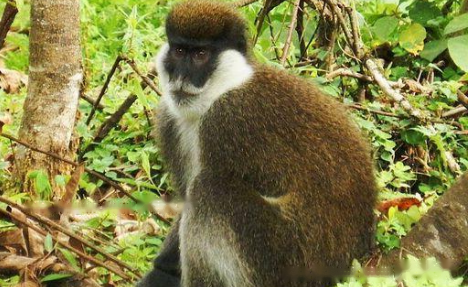
The Bell Mountain Green Monkey is a medium-sized monkey, with an adult male weighing 4-8 kg, an average body length of 50 cm, and a female weighing 3.5 ~5 kg, body length about 45 cm. Their chest, abdomen and inside of their limbs are white, and their cheeks are hairless, but they are surrounded by a dense, soft white fur that accentuates the outline of their dark skin.
III. Living habits
Bell Mountain Green Monkeys are highly social animals and like to live in groups, with each group ranging from 7 to 80 large groups It is a very intelligent animal, and members of the group usually communicate emotions by raising their eyebrows, squinting, and pouting.
The Bell Mountain Green Monkey mainly feeds on fruits in the rainy season, but in the dry season or after a fire, the Bell Mountain Green Monkey will go to the grassland to forage for edible plants, including grasses with little nutrition Leafy grass roots, also eat bamboo shoots, roots, leaves, flowers and insects of young bamboo.
Four. Reproduction
The social structure of Bell Mountain Green Monkey is dominated by males and it is a polygamous mating system. Breeding once a year, females are sexually mature at 4 years old, and the gestation period is usually between 163 and 165 days. From birth, female monkeys carry offspring closely on themselves, and take care of the young for about 1 year until they are completely weaned. and independence.
At present, the main threat to the survival of Bell Mountain Green Monkeys is the continuous loss and degradation of habitats. It is hoped that people will have a reverence for nature, so that the elves of the forest can continue to survive.

![[Original] Sharing of popular science knowledge of ringed map turtles](/static/img/11249/11249_1.jpg)