Fox squirrel, also known as fox squirrel, Kobe fox squirrel, Delmarva fox squirrel, oriental fox, is a sturdy squirrel species, mainly distributed in Canada and the United States and other regions, but rarely seen in our country. Because of this, many people know very little about the fox squirrel, so the editor has collected some relevant information.
I. Appearance characteristics
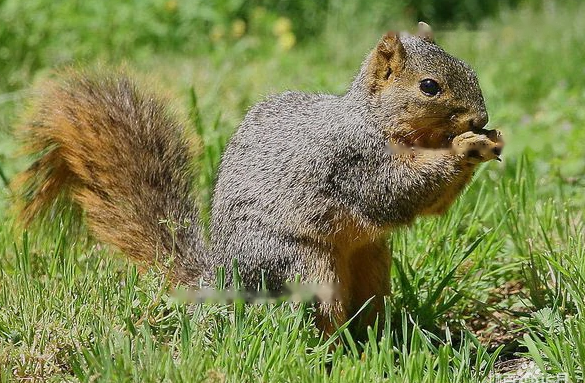
The fox squirrel is a large, thick-bodied arboreal squirrel. It is larger than the common grey squirrel, with an overall length of 45 to 70 cm, a tail length of 20 to 33 cm, and a weight ranging from 500 to 1000 grams. .
There are three distinct geographic differences in coat coloration: fox squirrels in most areas are brown-grey to tan, while fox squirrels in eastern areas often have black markings on the head, nose, ears, Paws are white, as in the Appalachian fox squirrel with a more striking pattern of dark brown, black face and white stripes on the tail. A uniform, isolated subspecies with black coats can be found in the south. The coat color of the Midwest ranges from tan-grey to tan, and the coat color varies with the season.
2. Distribution range
Distributed in British Columbia, Manitoba, Ontario, Saskatchewan, Canada; Mexico Avila; US Alabama, Arkansas, California, Colorado and other regions.
III. Habitat
Fox squirrels live in sparse forests with vegetation under the forest. The ideal habitat is located on the branches of big trees in the farmland. , choose pine and oak trees more. Often also occupies habitat on the edge of forests. Fox squirrels generally choose tree holes for their nests. There is one nest, and two nests are built on different trees, not far from each other. Nests are built on deciduous trees about 9 meters above the ground in winter when the leaves of the trees are sparse. As tree dens, natural tree holes or tree branches are generally used.
IV. Living habits
Fox squirrels are adapted to living in trees, they use hook-like claws and tails to hang upside down on branches. At dawn and evening, they also leave the trees and hunt on the ground. Foraging in forests on both sides of hillsides and river valleys. Active during the day, most active in the early morning, good at climbing and jumping on trees, and agile. Usually 1 or 2 more animals are active, but they migrate in groups when food is extremely poor. They build nests in trees or use tree holes to live. They like to be alone and live in the woods. Some also build nests in trees. It is good at climbing and jumping in trees during the day, and its long fluffy tail plays a balancing role. When jumping, it uses its hind limbs to support its body, and its tail is straight, and it can jump more than ten meters away. It does not hibernate, but in heavy snow and particularly cold weather, it will seal the hole with hay and hold its long hairy tail for warmth. After finding abundant food in autumn, they will use tree holes or dig holes in the ground to store food such as fruits, and at the same time block the holes with soil or fallen leaves.
Okay, the above is all the introduction about the fox squirrel, and interested friends can learn about it.

![[Original] Sharing of popular science knowledge of ringed map turtles](/static/img/11249/11249_1.jpg)