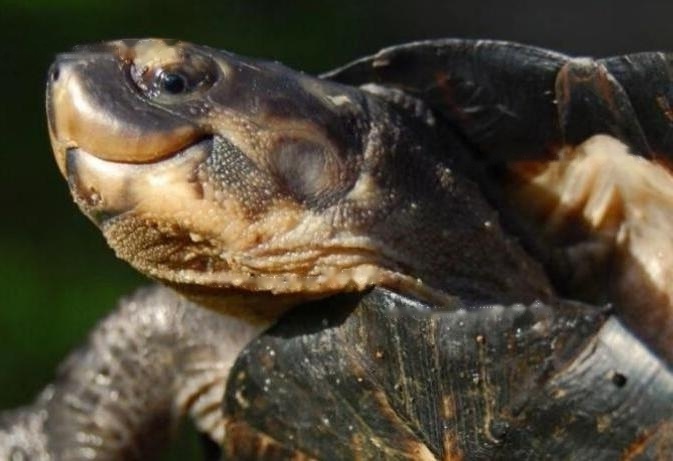
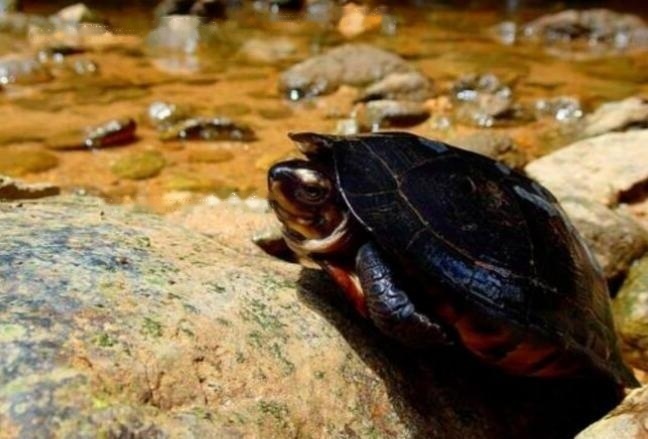
The rough-necked turtle is also called the white-cheeked tortoise. The adult appearance resembles a male tortoise that turns black when it matures. It is one of the more precious freshwater turtle species. Artificially bred thick-necked turtles to ensure the demand of turtle friends.
The stout-necked turtle is a medium-sized black freshwater turtle that spans southern Burma and as far south as Vietnam, Thailand, Peninsular Malaysia, Singapore, Sumatra, Java and Borneo. Commonly known as soft-shelled turtle, water fish, Tuanyu and Wang Ba, etc., oviparous amphibians and reptiles. Turtle meat is delicious and nutritious, and has the effect of clearing heat and nourishing yin, calming the liver and quenching wind, softening firmness and dispelling knots. It is not only a delicacy on the table, but also a nourishing medicine and traditional Chinese medicine material with a wide range of uses.
Chinese name: BlackMarsh Turtle
English name: BlackMarshTurtle
Kingdom: Animalia
Phylum: Chordat
Sub Door: Vertebrata
Class: Reptiles REPTILIA
Suborder: Cryptodira
family : Turtle family Emydidae
Subfamily: Freshwater turtle subfamily Batagurinae
Genus: Siebnrockiella
Species: Crassicollis
Distribution: Distributed across southern Myanmar, south to Vietnam, Thailand, Peninsular Malaysia, Singapore, Sumatra, Java and Borneo.
Characteristics of Rough-necked Turtles
The appearance of Rough-necked Turtles looks very ordinary, with neither fancy carapace nor strange shapes, it is a super normal turtle Class, but with such an ordinary appearance, it still wins everyone's love. This may be the simple charm.
The rough-necked turtle is a medium-sized black freshwater turtle that can pass through three ridges on the carapace of its juveniles (although adults have only one ridge) Different from other turtles in Borneo. The rear of the carapace also has a serrated edge, and the adult vertebral scutellum area is flattened. Adult males can be identified by a relatively longer and thicker tail with a slightly recessed plastron. In addition to this, adult females retain light-colored head spots, while males have these spots that fade as they grow.
2. Precautions for purchasing thick-necked turtles
1. Generally, thick-necked turtles cannot be left out of water for a long time. If they are left out of water for a long time, the upper and lower eyelids will stick together and cause infection. The edge of the carapace is easy to turn upwards to cause rotten nails [a healthy thick neck carapace is also slightly turned upwards
2. If red spots are found on the limbs, head and neck of the turtle, this is a relatively common disease of the thick neck , not very good treatment
3. Since the thick neck is a wild turtle, no matter how much there is a little trauma, as long as it is not very severe, it will be fine
4. Is there any secretion from the nose?
5. Whether there is a bad smell in the turtle's mouth, if so, it may be stomatitis, which is extremely difficult to cure
6. Pay attention to whether there are fish hooks
7. It's better to bite people
8. Pay attention to whether there is white secretion between his nails, if there is, it is rotten armor, and thick neck will have rotten armor
9. Pick the rest according to the ordinary turtle method
Rough-necked turtle
The rearing of Rough-necked turtle is not that complicated, but as an endangered species, the harsh living environment in the wild makes it difficult The survival of a species is getting harder and harder. Now, many artificially farmed rough-necked turtles are popular in the market, which has a certain effect on the protection of this species.
The thick-necked turtle is a vulnerable species listed in the IUCN Red List of Threatened Species, and one of 11 endangered Asian turtle species that were discovered last year.
1. Water quality: Since the thick-necked turtle belongs to the swamp turtle, it generally lives in the swamp in the place of origin, so it does not need to be too clear, and it is best to expose it to the sun for a few days.
2. Environment: The thick-necked turtle is relatively timid compared to other turtles, so keep quiet, especially for new turtles. You can see the bottom of the water, which is better for opening meals. There is no need for this after opening a meal. It is enough not to have too much.
3. Temperature: The best temperature for general breeding is; about 25 degrees, 12~15 degrees can also eat but not a lot, this turtle is not resistant to cold, needs to be heated in winter and cannot hibernate
4 .Eating: After arriving home, it is best to keep a quiet, dark environment with a suitable temperature for 3 to 7 days, and then feed it later. In my personal practice, it is better to use small fish and small shrimp without the shrimp gun, or you can use some Meat is the starting point of the meal, and you can feed some vegetables and fruits properly at the beginning. My experience is that they generally like to eat pears and pumpkins, but they cannot be used as staple foods.
5. Filtration: Because the thick neck has high requirements for water quality, and this turtle likes to be quiet, the filtration equipment used must be established. A relatively good biochemical filtration system is best. Can be equipped with UV lamps.

![[Original] Sharing of popular science knowledge of ringed map turtles](/static/img/11249/11249_1.jpg)