Taiwan kukri snake, as the name suggests, this snake has a small head and a small body. The more typical feature is that there is an inverted V pattern on the head, and the body color of the young snake will gradually change with age.
This species has been included in the List of Beneficial or Important Economic and Scientific Research Terrestrial Wild Animals Protected by the State issued by the State Forestry Administration of China on August 1, 2000.
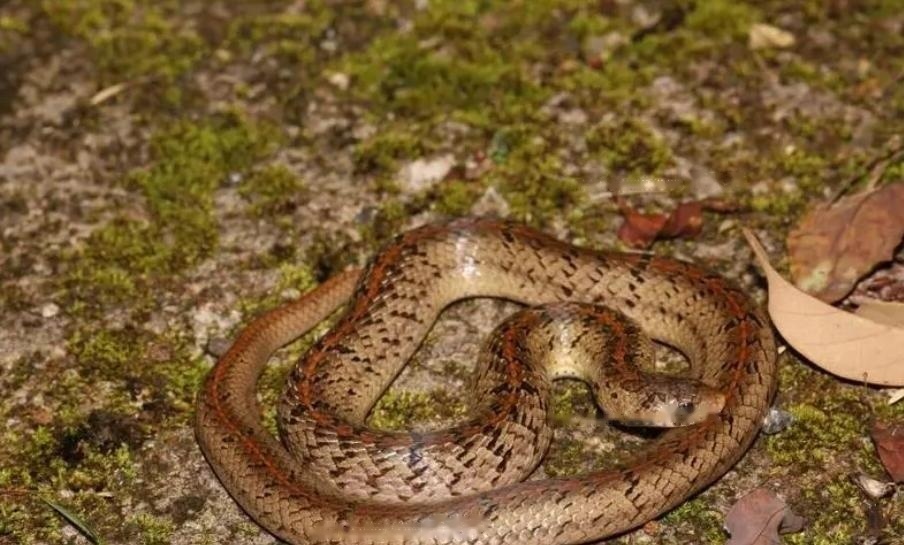
Taiwan small snake The body length of the head snake is about 95CM, the head is small and oval, the snout end is short, and the snout scales extend upward, and part of the snout scales can be seen from the top of the head. There is a brick-red longitudinal stripe extending from the neck to the tail in the center of the body, and there are often a series of dark-brown wavy stripes at the same distance on both sides of the longitudinal strip, and the ventral surface is brown-white. There is a distinct dark brown inverted V-shaped marking on the back of the head, and sometimes another less obvious inverted V-shaped marking on the front. The number of dorsal scales is 19. Teeth at the back of the upper jaw are specialized to be large and narrow.
Living environment of the Taiwan small-headed snake
The Taiwan small-headed snake prefers a bushy environment in the wild, and its temperament is gentle and occasionally aggressive. If you keep it at home, don't let children touch it, just in case it is hurt. When raising non-venomous snakes, you need to prepare the following things.
Feeding When it comes time, you need to put it in a large glass container with a lid that is half the length of the snake and one-third the width of the snake. Put a feeding basin and a drinking basin in it. This basin has two purposes, one is drinking water, and the other is bathing, so this basin must be able to accommodate its entire body. The container also needs to be covered with thick sand. Then bury a small flower pot in the sand to make a small snake nest, put some branches, it is best to hang a thermometer and a hygrometer on the inner wall of the container and the container must be well ventilated.
Be aware that snakes are only interested in live food, so feed them frogs and chicks. Snakes do not like to stay in places with very strong light or very cold and humid places. The temperature can be controlled at about 18 to 30 degrees during feeding. Except for hibernation, the temperature difference between day and night should not exceed 6 degrees.

![[Original] Sharing of popular science knowledge of ringed map turtles](/static/img/11249/11249_1.jpg)