Sliding lizards are slender and slightly flat, with the head slightly shorter than the tail. The head is slightly wider than the neck, the snout is short and the end is round and blunt, and the snout scale is wider than the height, which can be seen from the same; the nose scale is large and complete, and the nostrils are located in the center; there is no upper nose scale; the frontal nose scale is single, wide It is long, its anterior border meets the snout scale in the middle, and the incision is shorter than the incision between the frontal and nasal scales; the two frontal scales are tangent to each other at the anterior medial angle and the midline;
The frontal scales are narrow and long , the widest in the front half; 2 fronto-parietal scales, slightly larger than the central interparietal scale, tangent to each other with the anteromedial border before the interparietal scale; 2 parietal scales, larger than the frontal-parietal or interparietal scales , cut each other into a short suture behind the interparietal scales; 2 or 3 pairs of cervical scales;
4 supraorbital scales, the first 2 are tangent to the frontal scales; 7 upper eyelid scales; 2 cheek scales, the front is higher and the back Longer; 2 anterior temporal scales, 2 posterior temporal scales, the superior anterior temporal scale is the smallest, and the superior posterior temporal scale is the largest; there is an oval transparent eyelid window in the center of the lower eye; the ear hole is slightly oval, larger than the glaring window but smaller than Orbital, smooth peripheral edge without valve protrusion; tympanic membrane subsidence; upper lip scales 7 on the left and right, the first cut off the lower edge of the nose scale, the fifth just below the middle of the eye, and the seventh larger; the cheek scales are wider, followed by There is 1 larger chin sheet; 7 lower lip scales on the left and right. Smooth scales all over the body.
The dorsal scales are wider than the lateral scales, but not twice as large as the lateral scales; there are 28-30 scale rows in the middle of the ring body; there are 79 scales in a longitudinal row on the dorsal midline from the back of the parietal scale to the level of the posterior edge of the thigh -84 scales, the size of ventral scales and dorsal scales are similar, there are 87-97 scales in a longitudinal line from the back of the chin to the front of the anal scales on the ventral midline; 2 anal scales, larger, between the dark longitudinal bands on the side of the body The scales in the middle of the back are 4 rows plus half rows on the left and right lateral sides. The limbs are weak, and when they face each other, the distance between the fingers and toes is about equal to or slightly longer than an arm's length; the hind limbs of the flap are five. Five toes; all with claws.
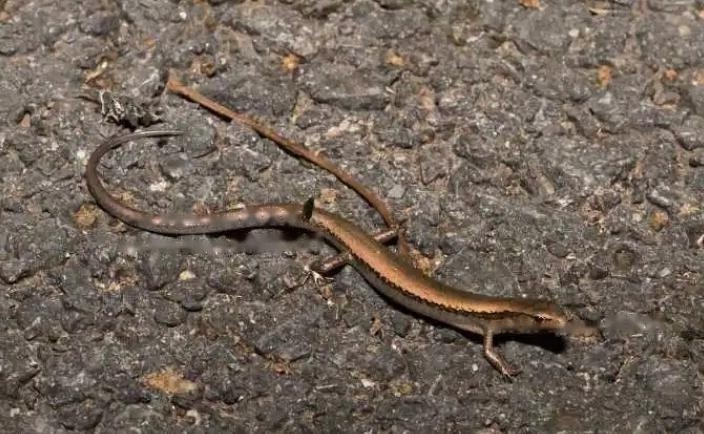
Refers to the length order 3, 4 , 2, 6, 1, 4, 3, 5, 2, 1 in the middle and long order; 13-17 lower petals of the fourth toe. The tail is cylindrical, Qinling slippery lizard: the end is tapered; the scales in the middle row under the tail are relatively broad. The back of the body is gray-brown. The upper half of both sides of the body starts from the nostrils, passes through the eyes, passes through the upper edge of the ear holes, above the base of the limbs, and extends backward to the tail, each with a tan or dark brown longitudinal band; this longitudinal band accounts for about 2+2 in the middle of the body. (1/2) The scales are lined, the upper edge is straight, and the lower edge has continuous concave and slightly wavy.
On the back between the longitudinal bands on both sides, from the neck to the front of the tail, there are four chain-like longitudinal lines of tan or black-brown dots, and the lower part of the longitudinal bands on both sides is blue-gray or gray-white , mostly without spots, only slightly reddish brown under the fingers and toes. They live on sunny slopes at an altitude of about 3,000 meters. They are mostly active in the bushes or grasses during the day, and they also hide under the rocks. Mainly prey on small insects. Ovoviviparous. Domestic distribution in Qinghai, Shaanxi, Gansu, Ningxia, Sichuan and other provinces.
Ecological habits: limited to some areas, with a small number of ethnic groups, inhabiting bamboo forests in low-altitude areas or orchards with less disturbance and other reclaimed environments, found in the Zhushan area of this county, and unique to Taiwan kind.

![[Original] Sharing of popular science knowledge of ringed map turtles](/static/img/11249/11249_1.jpg)