Recently, in the Lushan National Nature Reserve (Lushan Nature Reserve for short), infrared cameras deployed in the wild captured precious pictures of the activities of the national second-class protected wild animal white pheasant.
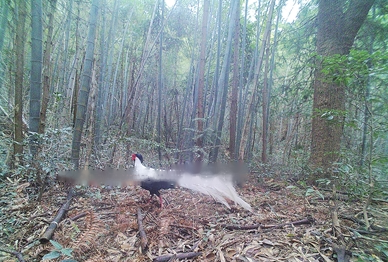
In the monitoring screen, I saw the white pheasant in the woods looking down and digging for food, looking around alertly. A male white pheasant passed by, flapped its wings and made a sound, and the female white pheasant heard the sound and looked for it, with a playful and cute image. According to reports, the white pheasant is a resident bird in the Lushan Nature Reserve. It is mainly distributed in Zhejiang, Fujian, Anhui, Jiangxi, Hunan and other provinces across the country, with as many as 16 subspecies. It mainly inhabits subtropical evergreen broad-leaved forests below 2000 meters above sea level. Alert, timid and afraid of others, when frightened, they usually run from downhill to uphill. Usually it rarely takes off, and it also rushes up trees in an emergency, usually in pairs or in small groups of 3 to 6, sometimes as many as 16 to 17 individuals in groups in winter.
In recent years, the Lushan Nature Reserve has carried out infrared monitoring work, monitoring the national first-class protected wild animals white-necked long-tailed pheasants, second-class protected wild animals such as white pheasants, leopard cats, and three-you protected wild animals Red deer, wild boar, etc. The strong protection of the ecological environment in the area over the past 40 years in Lushan Nature Reserve has provided a good habitat for wild animals to multiply and thrive, and has drawn a new picture of harmonious coexistence between man and nature.

Subscribe to Newsletter
Professional platform for pets, dogs and cats.
![[Original] Sharing of popular science knowledge of ringed map turtles](/static/img/11249/11249_1.jpg)