The rabbit has always been a symbol of cuteness in people's eyes. It is distributed in all corners of the world and is deeply loved by people in all countries, except Australia. In the past time, Australia and the Rabbit have fought a 150-year war, and Australia has been defeated badly. As the only country in the world defeated by animals, what is the situation?
One, 24 rabbits.
Australia has a special geographical location in the world. It is surrounded by vast seas. Due to the long-term distance from other continents, the species in Australia are very different from other places, mainly marsupials, such as Kangaroos, thylacines, etc.
In fact, there were no rabbits in Australia in the past. After the start of the maritime colonial era in the 18th century, Australia was originally a British colony and was used by the British to exile prisoners.
As time goes by, Australia's population increases, opportunities and challenges coexist, attracting more and more people to Australia.
In 1889, a British farmer named Thomas was going to Australia to settle down and develop. He brought a lot of seeds and livestock, including 24 rabbits.
When Thomas settled in Australia, the number of rabbits he carried began to grow, and some escaped into the wild, which should have been a trivial matter, but did not expect this to be the beginning of the disaster of the century.
Two, 10 billion rabbits.
The world we live in has a complete biological chain, one link after another, and any species will not experience explosive growth in a short period of time.
Like rabbits, in nature, they have little habitat, food shortage, and the capture of natural enemies, the number of rabbits is forever limited to a range.
But it's different in Australia.
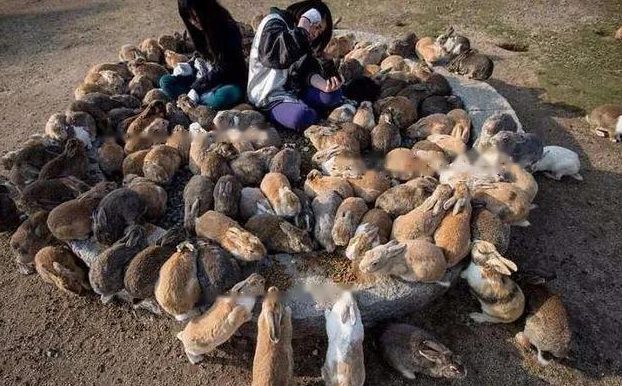
First of all, Australia has a mild climate and suitable temperature, which is especially suitable for the growth of grass, and the terrain is flat, with many endless prairie. This is the perfect home for a rabbit to live in. With such a wide grassland, rabbits do not have to worry about habitat and food at all, and even rabbits can be picky eaters and only choose the freshest grass to eat.
Secondly, Australia has very few medium and large carnivores. There are no traditional natural enemies of rabbits such as coyotes and eagles. The only threats to rabbits are thylacines and wild dogs. These two creatures are native to Australia. The species has its own diet, and they have poor stamina, so rabbits who are good at running are not their first choice.
Only in special circumstances will they choose to hunt rabbits, but for Australian rabbits, natural enemies are basically negligible.
In fact, there were dozens of large and medium-sized carnivores in Australia a long time ago, but tens of thousands of years ago, the aboriginal people who first set foot in Australia felt that these were threatening animals. Within a short time, they were all captured and killed.

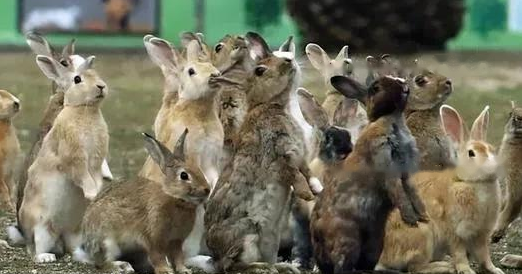
When all conditions are favorable, the rabbits will not have any worries, they will start to eat, play, and breed frantically. The number of rabbits soars rapidly in a very short period of time. 10 billion.
Until people find that their pastures are becoming more and more desolate; it is more and more difficult for cattle and sheep to get enough food; and their income is getting less and less.
It was only when people found out that something was wrong, they began to look for the reason, and soon they found the murderer - the densely packed rabbits.
There is a reason why rabbits reproduce so quickly. A female rabbit has a lifespan of about 7-8 years and can get pregnant four times a year, producing 2-4 puppies each time, while only needing In half a year, these little rabbits can mature and reproduce.

In the nature of rabbits, the survival rate of rabbits is not high due to food, climate and natural enemies, but in Australia, the paradise, the survival rate of rabbits exceeds 95%. This is the real reason for the explosion in numbers.
They ran from the farm in the northwest corner and spread in all directions, and in a few years, they were all over the grassland in Australia.
Three, the first human-rabbit war.
In addition to eating grass, Australian rabbits sneak into the crops and nibble on all the plants they see. Like locusts, no grass grows wherever they go.
The farmers couldn't take it anymore. In 1887, they spontaneously united and established the Rabbit Killing Alliance with the Australian government. Shouted out the slogan to eliminate all long-haired rabbits.
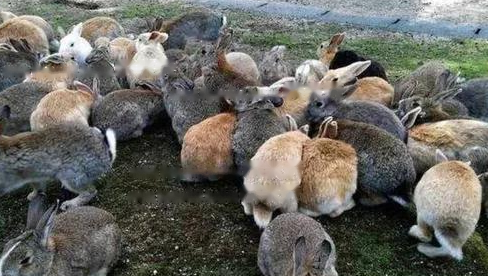
The first Australian Rabbit War broke out.
There are too many rabbits, and the efficiency of killing them by hand is too low. The Australian government is so concerned that it directly offers a reward of 25,000 pounds to recruit rabbit killers.
This amount was a huge sum of money at the time. Once the reward was issued, it quickly attracted a large number of people. The French biologist Pasteur was the most promising, and he proposed a virus prevention method.
After research, Pasteur finally chose chicken cholera bacteria and began to put it into the wild. Unfortunately, this virus has little effect on these savage rabbits. They were all alive and kicking. On the contrary, the farmer's sheepdog died of poisoning.
Everyone knew the war was lost, and Pasteur left Australia disheveled.
Fourth, the second human-rabbit war.
The war was lost, people had nothing to do with these rabbits, and everyone could only endure the unhappiness and let these rabbits run amok.
At that time, it was common to see desperate ranchers with hunting guns and hounds, chasing rabbits all over the mountains and fields.
Until 1901, a high-ranking official in Australia, his farm was ransacked by crazy rabbits. Everywhere responded.
The slogan has been shouted, but there is still no way to eliminate rabbits. The Australians who were forced to use the time-honored method-fence isolation method.
In the next time, the Australians started the frantic road of repairing the fence, repairing on the grassland, near the farm, repairing the vegetable field...
For 6 years, Australians spend their time repairing fences, and fences all over the country, the longest is more than 1,500 kilometers, making it one of the longest fences in the world.
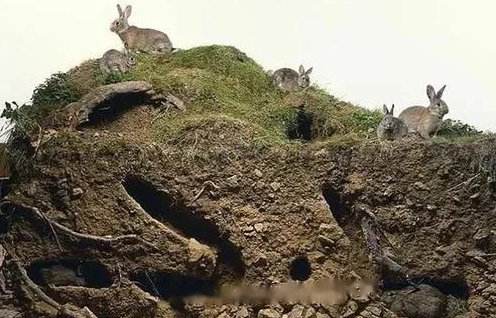
But Australians must have never heard of the phrase Three Caves of Crafty Rabbits. Building fences is just their wishful thinking. Crazy rabbits have made countless holes. The roads under the fences lead in all directions. war.
The Second Human Rabbit War was such a hilarious failure.
5. The third human-rabbit war.
Australians, who have experienced two failures, are completely desperate. After many years, I suddenly saw that in many parts of the world, natural enemies were used to solve invasive creatures, and the effect was remarkable.
As if seeing the light of day, the distressed Australians immediately changed their minds and used biological control methods to solve the problem and look for the natural enemies of rabbits.
Soon the fox entered the field of Australians.
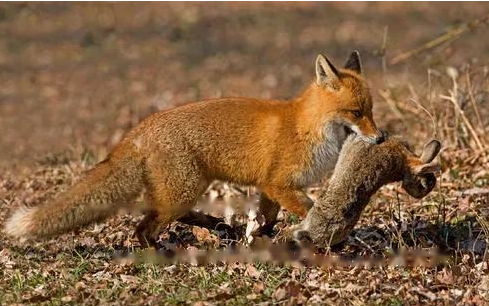
The third human-rabbit war has begun again.
Australian experts, after long-term investigation and research, selected a fox that likes to eat rabbits, spent a lot of energy, purchased dozens of them from abroad, and put them all into the wild.
Once the foxes were put into use, the initial effect was indeed very significant. The number of rabbits decreased significantly. Watching the increasing number of foxes, Australians saw the dawn of hope.
But the foxes slowly discovered that the Australian marsupials are generally slow and unresponsive, making it easier to hunt successfully, so they turned their heads to catch marsupials.
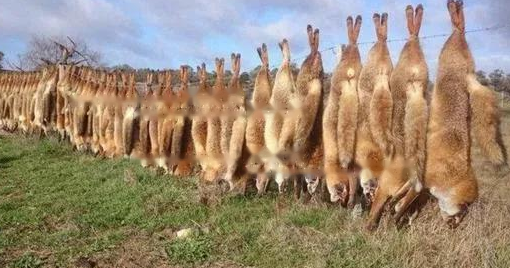
In this way, the rabbits are left alone again, but the number of foxes cannot be controlled. The foxes eat and drink every day, and have no natural enemies. The number has risen sharply. So far there are more than 5 million foxes in Australia has become the most threatening invasive species after rabbits.
Sixth, the fourth human-rabbit war.
In the 1990s, the scientific and technological strength of human beings developed rapidly, and the Australian government decided to use advanced technology to solve this problem that has been plaguing for many years.
They also adopted the virus control method, using the now developed biotechnology, specially researched a highly contagious virus for rabbits.
The government even dispatched planes to spray the virus on a large scale in the wild. When the virus came into contact with the rabbit, the rabbit would die within a few days, and the virus would spread rapidly.
This method is indeed effective. Soon after the virus was released, the corpses of rabbits could be seen everywhere, and the entire grassland was empty. People cheered and celebrated the victory.
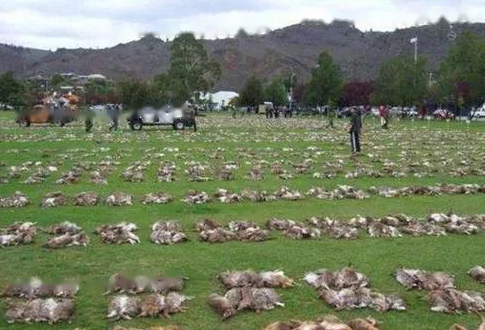
But the good times didn't last long. A small number of rabbits born with antibodies did not die. After a large number of other infected rabbits died, a huge living space was freed up. Sufficient food made the number of such rabbits skyrocket again.
A few years later, the number of rabbits has once again reached billions. Although the number is not as good as before, it is only a matter of time before the rabbits recover. The fourth human-rabbit war failed.
This time-consuming and laborious man-rabbit war in Australia has failed. It has been a full 150 years. I wonder how long this war will last?

![[Original] Sharing of popular science knowledge of ringed map turtles](/static/img/11249/11249_1.jpg)