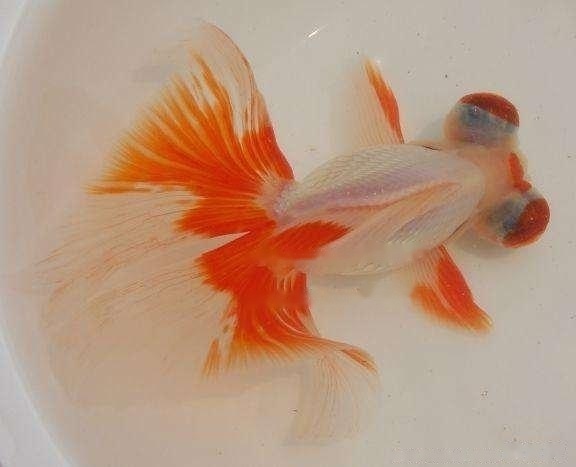
Generally, gold fish like to be paired, not only to make a good luck, but also to make the fish in the fish tank more hapiness. But distinguishing the male and female of goldfish is not everyone's ability. Today, I will introduce some good methods to distinguish the age, male and female and the water quality of goldfish for aquarists. Let's take a look!
1. How to judge the male and female of goldfish
1. Observe the body shape:
The female fish is short and round in shape, while the male fish is thinner and longer. If you are raising types such as tall head, tiger head, lion head, etc., you can observe the head. The sarcoid of female fish is lower and less plump, while the male fish is tall and plump.
2. Observation of the operculum:
The abdomen of the female fish is soft, from the abdomen to the anus, with no hard edges, and the abdomen is enlarged and rounded during the breeding period; the abdomen of the male fish is hard, from the abdomen to the anus. Obvious hard edges, not swelling during the breeding period. However, this point cannot be misjudged, because some goldfish species have swollen and rounded abdomens, both male and female, and must be carefully distinguished when they are separated.
2. Look at the age of goldfish from fish scales
1. Scale thickness distribution:
In the first year of life of most fish, the whole body will Covered with tiny scales, these scales consist of many flakes of different sizes, which look like a cone with a truncated apex. Thick in the middle, thin on the sides, the top layer is the smallest, but the oldest; the bottom layer is the largest, but the youngest.
2. The number and size of scales:
When the fish is young, the scales will look immature, small, and the number will be relatively small. As the fish grows slowly, new flakes are formed on its surface, and the number of flakes increases with the age of the fish. So the older the fish, the thicker, harder and larger scales.
3. Spinal operculum otoliths:
In addition to looking at the scales, there are other ways to look at the age of the fish. We can also judge the age of the fish by looking at the spine, gill cover, otolith, etc. of the fish. Of course, the method of judging is similar to observing fish scales, both of which use the annual rings and characteristics formed by different growth periods of the fish to determine the age of the fish.
3. How to judge the water quality of the fish tank
1. Since we want to judge the quality of the water quality in the fish tank, we must first find out the standard of good water. Generally speaking, the water quality is clear, flexible and not greasy. It is not as thin as pure water and does not contain any other substances, nor can there be water and fertilizer phenomena such as oil film, foam, protein bugs, and bacterial and algae outbreaks.
2. Good water should also be slightly water-colored, which is still the standard for cooked water. And raising water is raising bacteria, not only to raise nitrifying bacteria, but also to raise various other microorganisms that are conducive to maintaining water quality. If the water in the fish tank is too pure, colorless and transparent, it means that the water is too thin and contains too little bacteria.
3. The color of water is determined by the type and quantity of plankton in the water, among which are mainly various algae, such as diatoms, green algae, Euglena, Cryptoalgae, dinoflagellates and so on. A good water color should be a very light tea-brown, yellow-green, and oil-green. If the water quality is gray-white, gray-yellow, or dark-brown, it means that the water quality is bad.
4. Another way to judge the water quality of the fish tank is to use your own nose. Good water should be odorless, or have a slight fishy smell. When the water quality emits odor, strong behavior, and sour smell, it means that the water quality in the fish tank has been broken.

![[Dog Training 5] The training method of pet dog dining etiquette](/static/img/12192/12192_1.jpg)