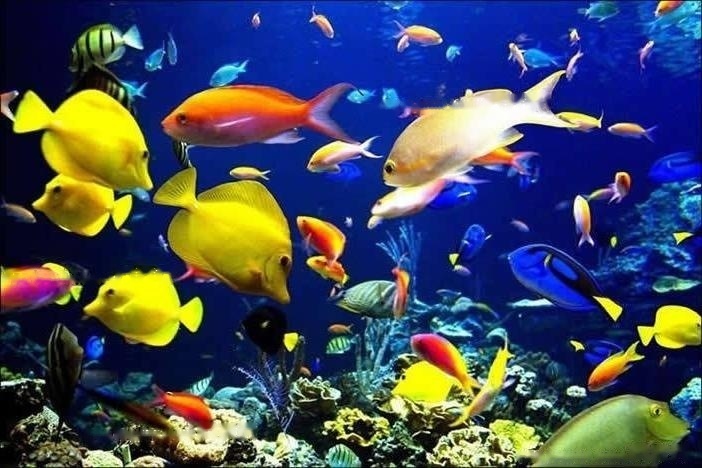
Many fish friends prefer to mix tropical fish. Although the colors in the tank are very beautiful, if you don't do your homework in advance, such as considering the species, Size, density, etc., often end in failure. About tropical fish polyculture skills and precautions. Follow the editor to learn about it!
1. Considerations for polyculture of tropical fish
1. The density of fish tank
In order to ensure the health of the fish, try our best to Reduce the breeding density. If high-density breeding is required, the water must be changed frequently, and the water body must be oxygenated for 24 hours.
2. Matching the size of the fish
Try to choose fish with the same shape to raise, avoid bullying the small, or the big fish directly treat the small fish as a snack.
3. Differences in fish personality
Some fish are aggressive, such as: dinosaurs, map fish, dragon fish; some fish are quiet, such as: swallows, colorful angelfish, it is recommended Keep them separately and observe the beauty of movement and stillness. If you have to appreciate movement and stillness at the same time, then don't bother yourself.
4. Fish regionality
Different fish have different origins, try to find as much information on the Internet as possible, and choose fish species of the same origin to raise, in order to improve the ornamental quality and improve the quality of life. The aquarium orientation training.
5. Up and down layers
Different fish have their own living habits, and each fish has a fixed habit after hundreds of years, thousands of years or even longer evolution , usually pay attention to the distinction, for example, dragon fish is an omnivorous upstream layer fish, so it needs to be matched with omnivorous downstream layer fish such as aliens.
2. Recommendations for polyculture of small tropical fish
1. Internal conditions of the fish tank:
The fish tank is 1.2 meters high, 80 cm high, 45 cm wide, and has landscaping inside. , aquatic plants, rocks, sunken wood, pebbles, various shells, bottom sand, etc.
2. Introduction of matching fish layer:
Upper layer fish: red Mary (red), black Mary (black), purple-blue peacock (blue).
Upper middle layer: Betta fish (multicolor), Flame Lili (red), Manlong (yellow, blue),
Middle layer fish: Big tiger skin (striped), glass Lala (transparent hanging color), glass walrus (blue), Dutch phoenix (multi-color), colorful skirt (transparent multi-color)
Bottom fish: red-tailed black shark (black), rat fish (yellow) .
2. Guide to polyculture of tropical fish
1. Polyculture of docile fish:
Guppy, moonlight, red sword, black mary , Golden Sailfin Mary, etc., traffic lights, silver screen lights, zebrafish, catfish (there are many species, all of them are very cute and highly recommended).
2. Mixed breeding of naughty fish:
Black skirt fish, cyprinidae tiger skin fish, rose crucian carp, zebrafish.
3. Mixed culture of small and medium fish:
Redtail shark, Rainbow shark Betta fish (only one), Blue Mansaurus, King Mansaurus, Pearl Mansaurus ( All Manlong and Blue Manlong are raised in the same way), cichlid, Chinese betta (only one).
4. Medium and large mixed breeding:
Backward swimming cats (can only be mixed into small fish tanks when they are very young).
3. Common mistakes made by polyculture fish
1. The placement of the fish tank
The unreasonable placement of the fish tank does not cause the temperature difference to change within a day. Large, it means that the fish tank is covered with moss, and the dissolved oxygen changes greatly during the day and night. Improper lighting configuration, suddenly turning on or turning off the lights, knocking on the tank wall causes the tropical fish to panic.
2. Polyculture of different attributes
When polyculture, do not pay attention to the attributes and individual differences of the polyculture species, tropical fish with different attributes cannot coexist, and carnivorous tropical fish bully or even eat herbivores Sexual tropical fish.
3. Differences in the strength of the snatch
Many friends do not know that those fish can be mixed, and they will all be raised together after returning. Some fish that eat fiercely will compete to eat the weak fish, resulting in uneven distribution of ingredients, and finally affecting the growth of fish.
4. Feeding water quality control
Feeding depends on personal preference, a full meal, a few days of starvation, either malnutrition in the same population, large or small, or fish due to insufficient food They bite each other and contract other diseases. The water quality must be stable. For more delicate varieties, large water changes should be reduced and the number of daily water changes should be increased.
5. Wrong medication for fish diseases
In the process of treating fish diseases with medication, if a variety of fish medicines are used together, pay attention to the order, otherwise it will not work optimally. Efficacy.

![[Dog Training 5] The training method of pet dog dining etiquette](/static/img/12192/12192_1.jpg)