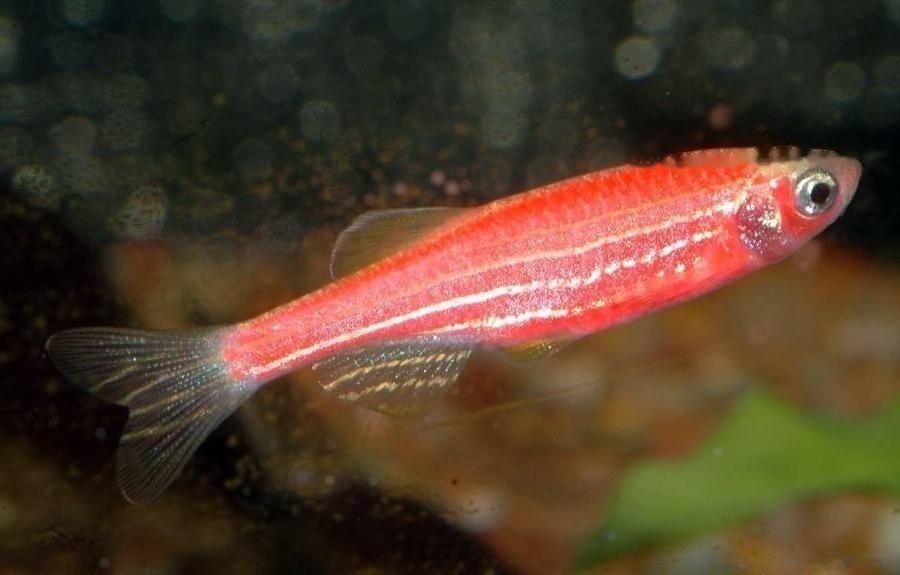
The red lotus lantern fish has a beautiful appearance, with blue-green and red Z-band-like patterns, also known as the traffic light fish. A favorite of tropical fish lovers. These fish usually swim around in groups, but they are beautiful, but they are very picky about the breeding environment, whether it is water quality, temperature or even bait. So how do you keep it? Follow the pet editor to learn about it!
1. Characteristics and habits of traffic light fish
1. Bright and diverse colors
Traffic light fish The body is petite, the fins are not large, and the total length is 3 to 4 cm. The body color is highlighted by a neon vertical band above the lateral line. From the eye to the front of the tail stalk, it is green and blue under the refraction of light, and the tail stalk is bright red, and flashes red and green when swimming. Raise dozens of traffic light fish, such as watching fireworks.
2. Requirements for rearing environment
The traffic light fish is gentle and timid, and belongs to the typical middle-tier fish. It has relatively high requirements on the breeding environment, the suitable water temperature is 22-24 degrees Celsius, and the water quality requires weakly acidic soft water (pH6.4-6.8, hardness 4-8). The feeding water should be kept clear, and the water should be changed less frequently. The environment should be quiet and avoid direct sunlight.
3. Not demanding on bait and feed
Not demanding on bait, fish, insects, water worms, and dry feed are all willing to eat.
2. Feeding methods of red lotus lantern fish
1. It can be mixed with small fish
The bait is mainly small live food, and it is preferred in the aquarium. The middle and lower layers swim in groups and can be mixed with other species fish, but the juveniles are too petite and should not be mixed with large fish.
2. Prohibit exposure to strong light
Fish like to live in dimly lit aquariums, and exposure to strong light is prohibited. The water quality of daily feeding is mainly old water, and it is not advisable to add too much new water; otherwise, it is easy to suffer from white spot disease.
3. The bait must be sieved first.
The larvae are small and have a small amount of swimming. Open the bait, sieve the egg yolk gray water with a 200-mesh net, and then feed it drop by drop with a straw.
4. Pay attention to the growth rate
When the larvae swim normally, they will be fed with egg yolk grey water screened by 150 mesh nets. Due to the slow growth of larvae, the feeding time of egg yolk-grey water is longer than other small species.
5. Different hatching water temperature
In addition, the hatching water quality of larvae is very soft, and the water temperature is completely different from the daily feeding water temperature.
6. Adjust the water quality for small fish
When the larvae grow to 5 mm, store some daily feeding water with the same water temperature in the 50X40X40 cm aquarium, and concentrate the larvae together with the water in the water. In the aquarium, the larvae are slowly adapted to the water quality of the daily water.
7. Prevent bacterial infection
At this time, larvae can be fed with small fish and insects, and 1-2 tablets of oxytetracycline can be dissolved in water to prevent bacterial infection.
8. Change the aquarium in adulthood
When the juveniles turn red and green on the surface, they are transferred to a large aquarium with a length of 80 cm or 100 cm, until they grow into adult fish.
9. Love to eat plankton
Feed a small amount of feed every day, so that the fish can finish eating within 10 minutes. The food that traffic lights like is small live bait such as plankton, and they can also eat commercial feed of better quality. Live bait such as small water fleas and gray water can be fed frequently to keep the fish light and color.
10. Water change in half a month
Replace a small amount of old water every half a month or so, and add dried tap water or distilled water to the original water level. The water change is mainly based on the bottom sewage, and the amount of each water change should not exceed 1/3 of the total amount, so as to avoid major changes in the water quality.
3. Precautions for raising red lotus lantern fish
1. Enough sunshine in winter
If there is no condition to keep the water temperature of the fish tank, it is necessary to keep the water temperature in this cold winter. Give the fish enough sunlight.
2. Put aquatic plants in the fish tank
Put some white rice stones and some aquatic plants in the fish tank, but remember that the aquatic plants must be appropriate.
3. Do not mix with big fish
Remember not to mix with swallow fish and large fish.
4. Don't raise too many at a time
When buying fish, don't fish a group at a time, you should fish one or two together, so as to avoid some bad fish from mixing. Don't buy too much at one time, 10-20 is enough, and add more water in the fish tank.

![[Dog Training 5] The training method of pet dog dining etiquette](/static/img/12192/12192_1.jpg)