Chinese name: Ranunculus repens
Latin name: Ranunculus repens L.
Alternative names: Ranunculus fusheng, Ranunculus, etc.
Family: Ranunculaceae
Distribution area: Northern Asia, Europe, China
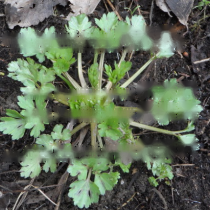
1. Morphological characteristics of Ranunculus spp Ground-growing, with short rhizomes, many roots clustered on the surface, stems noded and branched, apex glabrous and longitudinally striped, trifoliate, basal leaves with long petioles, leaves broadly rounded or broadly ovate Shape, the top has three lobes, the lobes are deep or fully divided, the lobes are diamond-shaped, and the edges have thicker serrations. The upper leaves are linear-lanceolate with few petioles. The inflorescences are sparse at the top of the branches, the petals are yellow or orange, and the oval is scaled. The fruit is slender and flat, glabrous and slightly curved. The flowering and fruiting period is May-August.
2. Habits of Ranunculus spp.
Ranunculus stolonifera often grows in ditch-side meadows, adapts to a half-sunshine growing environment, prefers sufficient light, cool and humid climate conditions, and is relatively cold-resistant. It can grow normally in low temperature in winter, and it is easy to suffer from frost damage in frost environment. In severe cases, it cannot be safely overwintered. Avoid heat. In hot summer, plant growth is hindered, and it is not drought-tolerant. In drought state, the leaves of plants turn yellow and affect flowering. The soil requirements are not strict, and a well-drained, fertile, loose neutral or alkaline soil is preferred. Shade tolerant, because the plant grows on the roadside grass, it is not resistant to trampling.
3. Cultivation of ranunculus
Ranunculus stolonifera is usually sown, select the seeds of Mylabris, level the soil for sowing, cover with fine soil after sowing, and bring it up with proper watering After germination, it is necessary to control the watering. After the true leaves grow, keep the soil moist, but not too dry, so as not to affect the growth of flower buds. After germination, sufficient light should be ensured, and the temperature should be controlled at about 15 ℃. The buds are unearthed. After that, it can be cooled appropriately. Fertilize every 15 days after the leaves grow, but it should not be too thick. The seedlings can be topped when they grow to 10 cm, and they can be planted after about 40 days.
Guess you like it
?G dish | black grass |菥?q| Mat grass|Porchia|Benefius| > Wildflower | Oil Vegetables | Geshanxiang | Snakeroot Grass | Mushroom |
Oxtail Grass | Children's Cai| Wannian Hemp|Wujiemang|
Little pandanus| Small cattail| Wild flax|Amaranth axillary| Rice Noodles|Spearmint|

![[Dog Training 5] The training method of pet dog dining etiquette](/static/img/12192/12192_1.jpg)