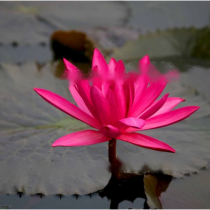
Chinese name: Nymphaea lotus
Latin name: Nymphaea lotus var.pubescens
Kingdom: Plant Kingdom
Phylum : Angiosperms
Class: Dicotyledonous Plants
Subclass: Protoperiana
1. Morphology of the pilose tooth-leaf water lily
The pilose tooth-leaf water lily is a perennial herb. Rhizomes stout, prostrate. Leaves floating on the water surface, papery, round, 15-26 cm in diameter, deeply curved at the base, lobes round and obtuse, nearly parallel, with curved and triangular-shaped sharp teeth on the edge, the leaf surface is smooth and glabrous, with small spots when dry , the back is reddish, densely pubescent, puberulent or nearly glabrous, and the handle is about 50 cm long. The flowers are large, 2-8 cm in diameter, the sepals are oblong, 5-8 cm long; the petals are 12-14, white, red or pink, oblong, 5-6 cm long, the top is obtuse, with 5 longitudinal Striped, stamens anther apex not elongated, outer whorl petaloid, inner whorl sterile, filaments enlarged, ca. 2 mm wide.
2. Uses of the water lily with pilose teeth
The water lily with pilose teeth is a landscaping material with high ornamental value in water. The pilose tooth-leaf water lily grows in low mountain ponds. Flowering and fruiting period from August to November (Southwest China). Distributed in southwestern my country, southern Yunnan, and Taiwan. India, Vietnam, Myanmar, Thailand also have. Water lily root can absorb mercury, lead, phenol and other toxic substances in water, and can also filter microorganisms in water. It is a rare plant material for water purification, so it is highly valued in urban water purification, greening and beautification. Meanwhile, water lily rhizomes are rich in starch and can be eaten or brewed. The whole plant is suitable for green manure, and its rhizomes are edible or medicinal. The rhizomes can also be used as medicine, used as a tonic, astringent, and can be used to treat nephritis.
3. Planting of pilose dentate water lilies
The flower pots of pilose dentate water lilies should be planted as far as possible, and those with leaves that open outward will be better than those with inward leaves. The leaves grow well, and the wider the pot mouth, the larger the flower (it has little to do with the size of the pot bottom). The depth of the flower pot will affect the flowering interval, and the deeper the interval, the longer the interval. Try to choose soil with higher viscosity, such as: clay, Yangmingshan soil. Then put a little long-acting fertilizer or root fertilizer on the bottom of the pot (too much will rot the roots), put about 1/4~1/3 of the soil in the flower pot, press it tightly, and then bury the bulbs in the soil with the buds facing up. Buried deep, the flowering interval will be longer but larger, and shallow buried, the interval will be shorter and smaller. After planting, move to a well-lit place, fill up the water, and wait for the long leaves to bloom (the leaves can be trimmed if there are too many).
Guess you like it
FishXingcao| Rush | Mushroom | Wildflower | Hornwort|
Duckweed | Cattail | Three white grass| Yellow calamus| Water bamboo leaf|
Dai| Da Ping| black algae| taro | calamus | wild fern | kidney fern | Ficus lobularis | | Threaded Iron | Gerbera | Black Beauty | Green Bully | Oregano |

![[Dog Training 5] The training method of pet dog dining etiquette](/static/img/12192/12192_1.jpg)