Chinese name: Rhinoceros horn
Latin name: Stapelia grandiflora
Aliases: starfish flower, stinky meat flower
Family: dill Family
Origin: Nanfei
1. Morphological characteristics of rhino horn
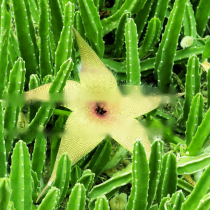
The rhino horn is a perennial succulent herb, with a plant height of 20 cm to 30 cm. The branches at the base of the stem are toothed and raised, gray-green shaped like a rhino horn. The flowers are five-lobed, star-shaped, and the corolla is very large. The back is hairy, the inner surface has lateral fine wrinkles, sparsely covered with hairy, pale yellow with lateral scarlet stripes, lobes ovate-lanceolate, apex acuminate, pale yellow, with pale black-purple horizontal stripes, margins Densely growing fine hairs with foul smell. The fruit is slightly branched, nearly cylindrical apex blunt and slightly hooked, flowering in autumn.
2. Habits of Rhinoceros horns
Rhinoceros horns are adapted to the full sun growth environment, preferring sufficient light, warm and humid climatic conditions, but do not like direct sunlight. The suitable growth temperature is 22℃-30℃, and it is not cold-resistant. The safe overwintering temperature is above 12℃. Below this temperature, the growth is hindered, and it is not resistant to frost. Frost weather is prone to frost damage. It is drought-resistant and can grow well in short-term water shortage. The soil requirements are not strict. Loose, well-drained sandy soil rich in humus is preferred. It is resistant to half shade, does not like too dark, and likes dryness and avoids water accumulation. Water accumulation is not conducive to root growth.
3. Cultivation of rhino horns
Rhino horns can be cultivated by ramets, cuttings and sowing. The ramets are suitable for combining with changing pots in early spring, and cuttings can be used all year round. Yes, seedlings are not commonly used, and seedlings grow slowly. 4-5 years before flowering. Watering should be controlled during low temperature in winter or high temperature in summer. Pay attention to temperature control during cultivation. In summer, it should be placed in a bright semi-shade and ventilated environment to avoid high temperature to avoid burning plants. Stop fertilizing during the dormant period. Plant pots are suitable for window sills, desks or desks as embellishments, and can also be used as outdoor rock gap settings. The interior is placed in the study, living room, and coffee table for viewing. It is also often used to arrange special gardens for succulent plants.
Guess you like it
Oxtail | Triangulaceae | Mustard greens | Coral vegetables | Water mint | |Five awns|
Small pandanus| Small cattail| |
Large-flowered wheat bottle grass| Tiger's Eye Evergreen | tassel Fritillaria | Xinjiang Asafoetida |

![[Dog Training 5] The training method of pet dog dining etiquette](/static/img/12192/12192_1.jpg)