Chinese name: Boyuan cold water flower
Latin name: Pilea cavaleriei Levl.
Door: Angiosperm
Class: Dicotyledonous plants
Order: Rosaceae
Family: Urticaceae
1. Morphology of oil vegetable
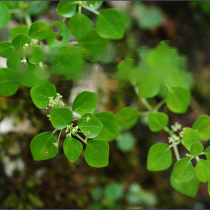
Oil vegetable is Perennial herb, the flesh of the stem veins is relatively fleshy, smooth and without hairy, with obvious nodules, the distance between the nodules is about three centimeters. The leaves are opposite, the shape is broadly oval, the decoration is slightly oblate, the length is 1.5 cm to 2 cm, the width is 1.5 cm to 1.8 cm, the front end is relatively blunt or sharp, and the root is slightly rounded or Truncated, entire, fleshy. There are three main veins, the petiole is 0.3 cm to 3 cm in length, and the stipules are triangular and less than one millimeter in length. The flowers are of the same sex, and the inflorescences are cymose, growing between the leaf axils. The flowers are very small, the male inflorescence stalks are 2 cm to 2.5 cm long, light green, and transparent.
2. Medicinal use of petroleum vegetables
Guangxi Chinese Herbal Medicine: Light in taste, cool in nature. Clearing away heat and detoxifying, resolving phlegm and relieving cough. Treating pulmonary tuberculosis and cough, heat poisonous sores Guangxi Medicine Plant Directory: clearing heat, diuretic water, detoxification. Treating fire scald, chancre accumulation, sores and scabies. Oral administration: decoction, 0.514 taels (2 to 4 taels for fresh ones). External application: smash for application. Control lung heat cough, tuberculosis: 1 to 2 liang of fresh oil vegetables, decoct in water. Treating bruises, soup burns, sores and boils: appropriate amount of fresh vegetable oil, smashed and applied to the affected area. To treat pulmonary tuberculosis, take 2 taels of fresh oil vegetable whole herbs, appropriate amount of pork bones, add 600 ml of water, fry to 400 ml, 1 dose a day, take 2 times. 3 months is a course of treatment. Clinical trial treatment of 40 cases, there is a certain effect.
3. Cultivation of oil vegetable
Oil vegetable is propagated by sowing. The seeds are small and hard, generally sown in spring, but also in summer, and the suitable germination temperature of seeds is generally above 23 ℃. Before sowing, the soil should be deeply ploughed, finely plowed, leveled and fertilized, and then the seeds should be mixed with fine soil and sown without covering the soil. The emergence time varies with temperature, humidity and depth. For early emergence, it is best to take seedbed seedlings. When the seedling grows to more than 15 cm, it begins to have a stimulating function, so when transplanting or planting, you should wear canvas or rubber gloves, and wear rubber shoes to avoid skin exposure. After the new shoots grow around the old plants, as the new shoots grow, the old stems on the upper part wither one after another and need to be divided. Dividing time can be carried out in winter and spring. The whole plant is dug up, the buds are cut off, and then planted around the garden at a plant spacing of 20 cm. It can play a protective role in that year, and even chickens will not dare to enter in the second year. In order to avoid affecting the growth and management of the main crops, the elongated branches and leaves can be cut off in a planned way, and the stems of the grass can also be blocked with wooden sticks.
Guess you like it
Chlorophytum japonica|Gerbera|Gerbera japonica| Dendrobium dendrobii| Shegan| Mirabilis| Du Ruo| Setaria| >
Rhizoma Imperatae | Striga | Manila Grass | Lian Qiancao | Golden Doll Hemerocallis | Viola | Weeda chrysanthemum | Liedang | Hollow Lotus Seed Grass | Trillium |

![[Dog Training 5] The training method of pet dog dining etiquette](/static/img/12192/12192_1.jpg)