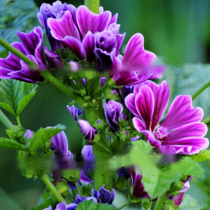
Chinese name: Mallow
Latin name: Malva Sinensis Cavan
Other names: Jingkui, Qiankui, Xiaoqianhua, Shuqi flower, chessboard flower, etc.
Family:Mallow family
Species:Mallow
1. Morphological characteristics of mallow
Mallow has many branches, Sparsely shaggy. The leaves are heart-shaped or kidney-shaped, with 5-7 crenulate obtuse lobes, 5-12 cm long, almost equal in width, the base is subcardioid to round, the margin is crenellated, both surfaces are glabrous or only sparsely covered on the veins Short strigose; petiole 4-8 cm long, nearly glabrous, but with long bristles in the upper groove; stipules oblique, ovate, serrated, apex acuminate.
2. The maintenance of mallow
The first is planting. Before the Qingming Festival, choose nutrient soil or humus soil, and place it in the sun for half a day after potting. flowering. The second is fertilization. Because mallow blooms more often, it needs enough nutrition. It blooms one after another from June to October. Topdressing with phosphorus-based fertilizers should be applied 1 or 2 times a month to make the flowers bloom continuously. The third is watering. During the high temperature season in midsummer, the basin soil should be dry and avoid wet. The fourth is pruning. Cut off dead branches, diseased branches, weak branches, dense branches and residual flowers at any time, so that there will be more side branches and more flowers. The fifth is to prevent freezing and keep warm. After winter, it should be moved indoors in time and placed in a sunny and warm place. Sometimes leaves will fall, and new leaves will grow again in the next spring.
3. Propagation of mallow
The propagation of mallow mainly includes cutting method and layering method. When cutting, choose 1-2 year old strong branches, cut them into about 10 cm, leave only the upper leaves and terminal buds, flatten the base, insert them into clean fine sandy soil, pour enough water, cover with plastic film, and place them under the shade. It can take root after more than a month; there are two kinds of pressing method: high pressure method and ordinary pressing method. The high pressure method can adopt the method of tying the ends of the plastic bag tightly. Can survive that year.
Guess you like it
Snow White | Taxus | Rhododendron | Lavender | Mint |
Copper Coin Grass | Dracaena | Green Apple | Morning Glory | Mosquito Grass | Basil | Ingot Tree | African Jasmine | Sage | Bamboo Cypress | Bamboo| Penglai Pines| Emeralds| Duck Palm| | Kale | Nantian Bamboo | Sansevieria | Water Hyacinth | Water Bamboo | Guangdong Evergreen | Wine Bottle Orchid |

![[Dog Training 5] The training method of pet dog dining etiquette](/static/img/12192/12192_1.jpg)