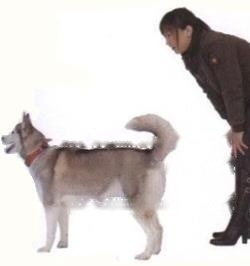
1. Search by designated route: This is the first step in the dog's defense training. pet.net believes that if you don't know much about dogs in advance, you must carefully check the dog's ear number before training to see if the dog has been registered and whether there is a formal breeding record. In addition, it is best to observe the dog's mental state from a distance to judge whether the dog's psychology is stable. The trainer can usually loosen the leash and approach the dog naturally, and if the dog is not shy or aggressive, then training can be done. If the dog is overly recognizable, avoids or has a strong tendency to attack, it means that the dog has a problem with the mental state or the character (temperament) is not ideal, and does not have the basis for training.
Determining a dog's walking route is as simple as walking a distance on an ordinary piece of land or grass. But the person needs to set up a certain number of turns and some special small objects on the road, the latter usually can use some cards similar to credit cards, of course, these cards must be placed on the road by the person himself. Once set up, the trainer can guide the dog on the road. The trainer can use a 10-meter leash to lead the dog, and try to release the leash as much as possible. Let the dog identify the path by sniffing the smell of the former's footprints, and at the same time let the dog recognize the small objects set in advance. The method of identification is usually to let the dog lie down first, put the small object between the two paws of the dog, let the dog remember it, and then it can officially walk. Ability to train, smell, and mental and physical endurance of the dog.
2 Command Obedience: The training focus of this program is to let the dog go through a series of following training, mainly to let it approach and follow a group of people. In the process of following, the human can intentionally burst the gunshot. At this time, the dog should ensure that there is no excessive startle reaction and no soft barking. At the same time, password obedience training also includes a series of training to accept passwords in situ, mainly including sitting down, lying down, standing up, etc. In addition, after the trainer changes the location, the dog does not move, and the dog should still execute the command as usual after the trainer changes the location. command, the dog cannot refuse to execute the command because the trainer's position has changed.
It also needs to be explained that when training, the trainer should ask the dog to lie on its stomach and keep a certain distance from the trainer, even if the trainer is on the other side of the training field. While other dogs are playing, the dog should also remain in a prone position there. Of course, all of this obedience training is a test of the dog's character (temperament), body structure, effectiveness and desire to work.
3 Basic defense techniques: The training of basic defense techniques focuses on testing the dog's courage, physical strength and agility, as well as the dog owner's control over the dog. These trainings include: searching for concealment, finding hidden people, and guarding the target person until the dog owner arrives; when the target person attempts to escape, the dog must have the desire to pursue and bite the target person with a sheath. The arm is held until the target person is escorted to the referee by the dog and the dog owner. If the target person attempts to attack the dog owner again, the dog must bite the target person without hesitation to stop him from harming the dog owner.
The last is a test of courage. When the dog owner asks the target person to run out of hiding from the other end of the training ground (usually 50 steps away), the dog must quickly Before the dog catches up with the target person, the referee gives a signal to the target person, and the target person immediately turns around, rushes directly to the dog, yells at the dog, and takes out a stick to threaten the dog. The dog should show fearless courage and attack the target person until it bites and subdues the target person.
In addition, the defense training also emphasizes that once the target person stops escaping, after the dog owner issues a stop command, the dog must immediately let go and stop attacking the target person. . Therefore, defensive training can confirm whether the dog is timid and fearful, and whether it can be unconditionally controlled by the trainer under any conditions, which is very important to the quality of the dog

![[Dog Training 5] The training method of pet dog dining etiquette](/static/img/12192/12192_1.jpg)