Among the many pets turtles, there is a splendid terrapin, which is the wood-carved terrapin, which is said to be gorgeous because the appearance of the wood-carved terrapin is very dazzling, like stars. There is also a reason for saying that the IQ of the wood-carved water turtle is the highest among pet turtles. Wood-carved terrapins can easily escape if they are not properly guarded under captive breeding conditions. The wood-carved terrapin not only has brain cells that similar pet turtles do not have, but also has the ability to climb over walls and walk freely over the fence. It is precisely because of the agility of wood-carved terrapins and the predation of wood-carved terrapins by native people that the number of pet turtles of this species is very rare now. In the face of the magical species of wood-carved water turtles, the editor of ZanPong.com will take you to understand the basics of wood-carved water turtles. So, what is the basic knowledge of wood carving water turtle?
Chinese name: Wood Turtle
English name: Wood Turtle
Latin name: Clemmys insculpta
Wood-carved terrapins belong to the genus Clemmys in the family Clemmys, mainly distributed in cool woodlands in North America and Canada. Streams, red maple swamps, swamp meadows, and farms in the countryside. Because of the strong terrestrial nature of wood-carved terrapins, turtle friends often classify them as semi-aquatic turtles. Wood-carved terrapins have better cold resistance than other species of pet turtles, because they are wildly distributed in areas close to the frigid zone. Even in a low temperature environment such as 5 degrees Celsius, turtles and turtles still live normally, but they will not eat. When the ambient temperature is lower than 5 degrees Celsius, the turtle will be in a hibernation state.
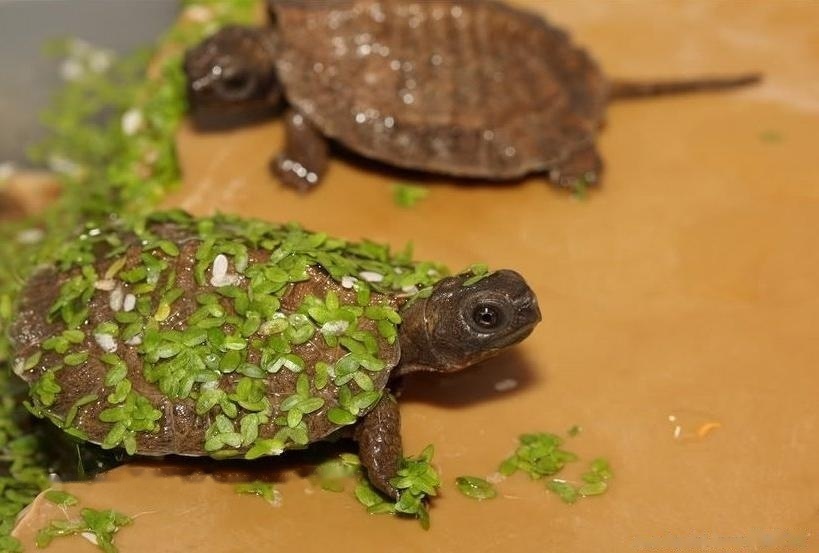
The wood-carved terrapin is 12.7-23 cm long and brown overall. The turtle's carapace has a very beautiful and unique pattern, and each scutellum has a relatively obvious concentricity Growth lines, so these scutes look like irregular pyramids. The ratio of the shell to the breastplate of the wood-carved terrapin is longer, the plastron is longer, usually yellow, and has black spots along the edge of the scutellum, without hinge joints. The limbs of most wood-carved terrapins are orange, and some are reddish. The carapace is brown, ribbed, and rather rough, as if carved by a knife.
From Nova Scotia in the United States, south to northern Virginia, and unconnected southern Quebec and the Great Lakes region to the west, to eastern Minnesota and Iho In the northeastern part of Huazhou, the vast area is the activity range of wood-carved water turtles. The wood-carved terrapin is the largest of the Clemmys genus. Mainly distributed in two areas, one is in the northeastern states of the United States extending to Canada; the other is in the area around the Great Lakes, the distribution area is relatively large. Because the distribution area is close to the frigid zone, the North American wood-carved terrapin is a turtle species that is particularly able to withstand cold, but it usually eats at temperatures above 15 degrees. If the temperature is lower than 5 degrees, they will still burrow into the sediment at the bottom of the river to hibernate.
The wood-carved terrapin lays eggs between May and June. Each litter lays 6-8 eggs. The eggs are oval in shape and have a flexible shell, about 41 mm in length. Shells between September and October. However, in northern regions, hatchlings may overwinter in their nests.
It is not difficult to reproduce. Usually, the identification of male and female is similar to that of other turtle species of the same genus. The male turtle has a thicker tail and a slightly concave plastron. Female turtles usually lay eggs once a year, with 5-13 eggs at a time, and the incubation period is quite short, at a temperature of 30 degrees Celsius, it only takes about 40 days to hatch. It is worth noting that according to expert research, the sex of young wood-carved terrapins is not determined by incubation temperature, but by genes, which is different from general turtles.
The wood-carved terrapin is a typical omnivorous turtle, feeding on insects, fish, shrimp, earthworms, snails, slugs and other animal bait, as well as strawberries , blueberries and other stems, leaves and fruits, wild mushrooms are the daily staple food. Basically, they are very active eating turtles. As long as they can eat food, they will eat it, so artificial feed can also be easily accepted, and there is no food problem in feeding. They are also very adaptable to the artificial environment, and they are regarded as healthy turtle species. Although the wood-carved water turtle is very beautiful, it is hard to find in the domestic pet turtle market. Even if it can be seen sometimes, it is expensive, so it is not a very popular species to keep.

![[Dog Training 5] The training method of pet dog dining etiquette](/static/img/12192/12192_1.jpg)