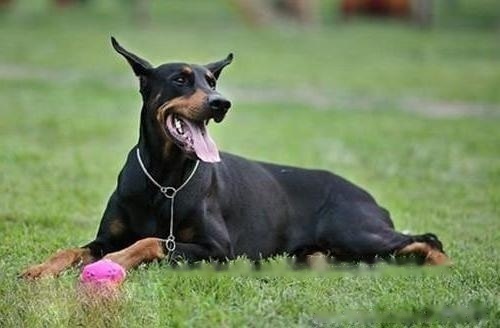
I often see police dogs on duty, and as long as new discoveries are made by the dogs's sense of smell, bravery, and quick response, so good Doberman how to train, will it lead to excessive behavior caused by excessive training? Biting is a way for dogs to protect themselves and exclude others One of the instincts, but this is only a narrow bite. The biting of the trained dog refers to the purposeful and step-by-step training of the dog, so that it can achieve the ferocious and quick completion of the commanded biting on the basis of only the instinctive biting in the narrow sense. How to do a good job in the training of dog bites.
1. Cultivation of Doberman's desire to bite
This is the basic work of biting training. Mainly in the dog's guts, bite force, physical fitness and confidence to lay the foundation for later training. The training environment for fighting for biting items can be divided into inside the kennel and outside the kennel. The initial training requires keeping the environment quiet and eliminating other external disturbances. In terms of training items, the dog's traction tools are required to be firm, and the items to be bitten should be diversified (such as towels, hemp sticks, worn clothes, wooden sticks, etc.). The training at this stage should achieve that the dog has no fear of the object competing for the object, actively bites the object, and has a strong desire to win. In the training operation, the owner can hold the silk fabric that the dog often takes to fully adjust the excitement of the dog and stimulate the dog's hunting desire. When the dog has a strong behavior of eager to get the item, the owner will give the item to the dog. And compete with the dog, at the same time reward the dog with the password good, or compete with the dog with one hand, and give the dog a pat with the other hand, and finally let the dog win the game with the owner. You can also hold a hemp stick or other biting objects to guide the dog outside the kennel. When the dog shows a strong desire to bite, send one end of the hemp stick into the kennel through the gap in the kennel, and hold the other end with the kennel. Dogs compete, and at the same time, they can make intimidating sounds or fake beatings to stimulate the dogs, and finally the dog wins. Note that you should try to choose items that are suitable for dogs to bite and easy for people to compete with. The strength and duration of the competition with the dog should be determined according to the actual ability of the dog, and the time and intensity of the competition should be properly controlled.
2. Cultivation of Doberman's ferocity and hatred
The cultivation of dog's ferocity and hatred is a very important stage of biting training. The main function is to cultivate the dog's biting power. It can be divided into two forms of training in the kennel and outside the kennel. The training environment requires the ground to be flat, without other obstacles, and it is easy for the dog and the trainer to run and fight. The dog's traction tool should be firm, and the trainer's protective measures are complete. The basic index achieved by training is that the dog has no fear of the trainer's guidance and other stimulation methods, and must actively attack the dog trainer. During the training operation, put the dog food on the inner door of the kennel, and then leave and hide it in a place where the dog cannot see. Make the action of competing with the dog for food. When the dog barks and scratches at the kennel, hit the kennel with a prepared stick (twigs or brooms), and at the same time make a sound of intimidating the dog to stimulate the dog, and finally help the trainer to escape The kennel ends. The trainer can also attract the attention of the dog by shouting or knocking on the door panel outside the door. The trainer brings the dog close to the door and gives the attention password. A good pitching tool, hit the ground or the dog to stimulate the dog. When the dog shows a strong aggressive behavior, the dog handler leads the dog to retreat, and the trainer enters the room to guide the dog. The best way to train for outdoor ferocity is with group tuning. Before training, according to the ferocity of the dogs, the dogs should be matched and grouped together, and the number of each group should be 5 to 8. Before the training starts, the dog handlers should arrange the dogs in a semi-arc shape (the spacing is about 3 meters), check the traction equipment, stand in the D shape, and wait for the training assistant to guide. At this time, the trainer suddenly appeared in the dog's field of vision in a hidden place, shouted loudly to attract the dog's attention, and waved the transfer tool to jump close to the dog. After reaching the dog, he first hit the ground with the transfer tool and threatened him. The dog is adjusted by the method, and then according to the individual situation of the dog, the stimulation method of whipping the dog body is appropriately applied, and the dog trainer encourages the dog on the side, and finally ends the training by helping the trainer escape from the training ground.
3. Doberman biting training under short traction state
The biting training under short traction state is the first of Ming Hushou biting Stage, through this stage of training, the dog can clearly identify the position of the sleeve to bite, cultivate the habit of not letting go after the dog bites, and improve the excitement of the bite. According to the different ways the trainer gives the sleeves, it can be divided into two forms of biting in front of the sleeves and backwards in the sleeves. It is required that the traction tool is firm, the trainer has complete protective equipment, and the size of the bite guard should be suitable for the dog's bite. The training should be such that the dog actively bites the trainer, has no fear of the whipping of the trainer, and does not slow down. In the training operation, you can choose a suitable outdoor venue, and the dog handler will signal the assistant to the trainer after preparing for the bite. The trainer wears protective equipment and fully guides the dog. When the dog has a strong desire to attack, the trainer lifts the sleeves half a meter away from the dog and stands still, and the trainer leads the dog up to bite. , when the dog bites the sleeve guard, the trainer swings the sleeve guard left and right to compete with the dog. At this time, the dog handler pats the dog while tightening the leash, so that the dog handler forces the dog to release the guard sleeve. The trainer ends the training by tuning the dog again. In the front-sleeve training, after the trainer has fully adjusted the dog at a distance of about 10 meters from the dog, he approaches the dog with an outer arc running route. , the dog trainer should relax the traction of the dog in time, so that the dog can jump up and bite to help the trainer. After the dog bites the cuff, the trainer will swing the cuff left and right to compete with the dog. The trainer will force the dog to release the cuff, and then the trainer will end the training by adjusting the dog again. In the back-sleeve training, the trainer has fully adjusted the dog at a distance of about 2 to 3 meters away from the dog, and then runs away from the dog. At this time, the dog handler leads the dog to keep up quickly. When the dog approaches the target, the trainer slows down the running speed, lifts the sleeve to bite the dog, and after the dog bites the sleeve, the trainer swings the sleeve and the dog from side to side. At the same time, beat the sleeves or the dog body with the adjustable whip to stimulate the dog's desire to bite. The dog trainer forces the dog to release the sleeve, and the trainer ends the training by adjusting the dog again. Pay attention to the coordination between the trainer and the dog trainer, and you can use language or gestures to communicate as necessary. The trainer's external stimulation to the dog should not be too large, otherwise the dog is prone to slow mouth.

![[Dog Training 5] The training method of pet dog dining etiquette](/static/img/12192/12192_1.jpg)