Chow ChowChow, Chow Chow, often referred to as Chow for short, is a very old breed , his accurate history has been lost in ancient China. The Chow as it is known today is remarkably recognizable from pottery and sculpture from the Han Dynasty (206B.C. to 22A.D.) in China. Other prehistoric artifacts suggest that the breed has an even much earlier history, perhaps originally from the Arctic and then to Mongolia, Siberia and China.
Occlusion selection:
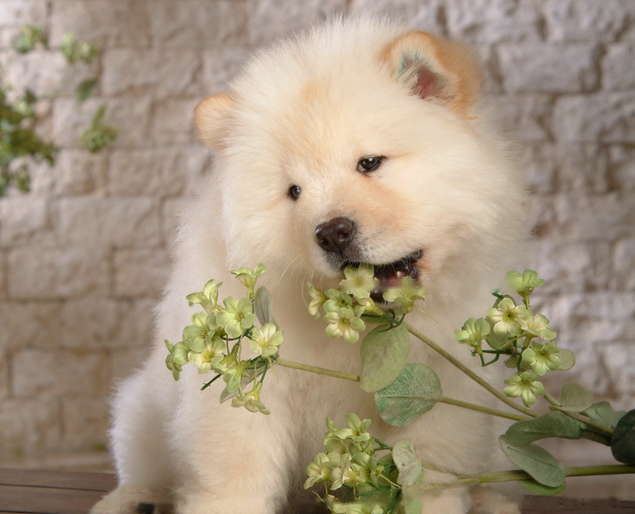
Assume that the litter is definitely healthy. Observe, pick the one that looks the most promising, and have the Chow Chow puppies stand upright on the table. Check his teeth and mouth first. The teeth are in a horizontal, scissors bite, and the upper teeth should fit (cover) the lower teeth tightly in front of the lower teeth, with no gaps. It is rare to see a Chow Chow with a crooked mouth, that is, an angled jaw, please check carefully for this defect, I have seen a few examples. Those with defective mouth shape should be eliminated. The puppy with a bad mouth shape is rarely as long as possible, and most of the time, the longer it is, the worse it is. Check the eyes, the eye shape at this age has great reference significance. Even dark eyes should be eliminated if they are large and round. Eliminate deep sunken eyes. Triangular eyes are ideal. The nose should be broad and the nostrils should be black.
Pigmentation and structure selection:
Then check for pigmentation and eliminate all tongue stains, which should not be the case even at this age. Relentlessly, I think this lack of pigment is an evolutionary regression and should be eliminated even if it improves later in life. We should breed puppies that are well-pigmented, desalination at any one time period is not advisable. Checking the ears now is relatively important in puppyhood, but it's also harder to pin down. I have found that the ideal ears in adulthood are mostly not erected until about ten weeks of age. With the puppy facing you, with its head raised, place your fingers in the middle of the ears, and gently lift the ears with a little pressure. The ears should stand up naturally (even if they fall down). Eliminate thin, high-rooted, close-together ears. The skull should be flat with a slight turn where it meets the muzzle. A round skull (sometimes forming a lump above the eye) that develops towards the snout and elongates the front face in adulthood. The neck is very important. Eliminate those that look like plugged in. The neck should be slightly arched, at a 65-degree angle to the horizontal line of the body, so that the Chow Chow can maintain a graceful posture in motion.
Bone selection:
Now look at the shoulders, which determine the width of the chest. Shoulders need to be at an angle or nicely sloping, otherwise it will lead to a very bad result: erect shoulders. Check the front like this: Touch the tops of the shoulder blades, gently lower the neck to make the shoulder blades more prominent, there should be a half-inch separation between the shoulder blades at this age, and an inch and a half in adulthood. If the spacing is insufficient, the front will be narrowed. If the shoulder blades are not spaced apart, it is certain that the front legs will form a loop shape in the future.
The leg bones should be round and strong. Puppies with good bone mass will have knuckle knees in puppyhood, which is an important sign of good bone mass in adulthood. Knock out very straight, thin leg bones, which, while looking pretty good at this age, probably won't be great in adulthood. Check carefully for any tendency to stretch the front legs. If the toes stick out at an angle, it is probably a sign of a narrow chest or thin feet. The feet should be round and compact, even in the earliest years. The hind legs should be as straight as the front legs, from the base of the tail to the ground. Very straight legs, if separated like Whippets, should also be eliminated. The base of the tail is very important and should be in line with the front of the hind feet. Too low a base is not advisable as it will upset the balance of a top dog. The ribs should be well stretched back, making the waist as small as possible. Ribs should be egg-shaped and not barrel-shaped. Coat color is not important at this time, one way to tell is to check the color of the tail.
![[Dog Training 5] The training method of pet dog dining etiquette](/static/img/12192/12192_1.jpg)