ShetlandThe Collie is very similar to the Collie, and its pedigree can be traced back to The Scottish Border Collie came to Shetland during the period when the Scottish Border Collie was bred with a smaller, brighter, longer-haired dog and received a scaled down breed. Later, it was occasionally bred with a long-haired collie. So, the Shetland Collie is as related in size and general appearance to the Longhaired Collie as the Shetland Pony is to the larger horse. While the similarities between the Shetland and Collie are quite obvious, the differences are also clear. The Shetland Sheepdog is a small, alert, coarse-coated working dog with long coats. He must be healthy, agile, and firm. The outline is very well-proportioned, nowhere is particularly exaggerated and out of proportion with the whole. Males appear majestic; females appear feminine.
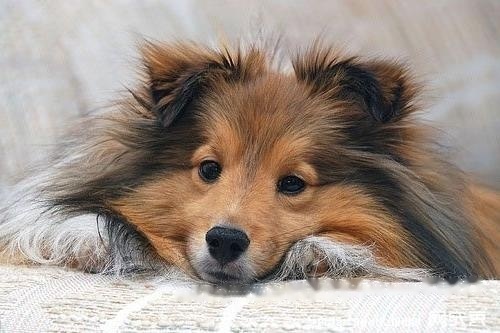
Shetland Sheepdog
The Shetland Sheepdog is about 13 to 16 inches tall (about 33 to 41 cm) at the shoulder. (Note: The height at the withers is measured as the vertical distance from the top of the shoulder blade to the ground with the forelegs parallel to the vertical when he is standing naturally.)
Disqualification: Shoulder Taller or smaller than standard size is disqualified and expelled from the arena. Overall, the length of the body (the distance from the front of the shoulder blades to the ischium [end of the pelvis]) appears slightly longer, which should be due to the proper width and angle of the shoulders and hips, while the back itself is rather short.
Head: Appearing delicate, when viewed from above and from the side, the shape of the head is a long, blunt wedge, extending from the ears to the nose direction is tapered.
Expression: The outline and lines of the head, the shape, position and posture of the ears, and the position, color and shape of the eyes, together form the expression. Usually the expression is alert, refined, intelligent and questioning. When confronted with strangers, there is alertness and reservation in his eyes, but never fear.
Eyes: Medium in size, dark in color, almond shaped, slightly slanted. The color must be dark black, except for rue dogs whose eyes are allowed to be blue or rue.
Defects: Light-colored eyes, round eyes, too large or too small eyes. The nictitating membrane is prominent.
Ears: Small, pliable, set high, 3/4 erect, tip folded forward. At rest, the ears are folded forward and tucked into the feathers.
Defects: Set too low, hound-like lobes, erect ears, bat ears, twisted ears. The pinna is too thick or too thin.
Head and muzzle: The top of the head appears flat and the back of the head is not prominent (at the back of the occiput). Cheeks are flat and blend smoothly into the rounded muzzle. Head and muzzle are equal in length and meet at the inner corner of the eye. The outline of the skull and the outline of the muzzle are parallel to each other, and the outline of the skull is slightly higher than the outline of the muzzle due to the slight but clear stop. The jaws are clean and powerful. The lower jaw is deep and well developed, the chin is rounded and extends into the nostrils.
Nose: Must be black.
lips: tight. The lip junction forms a smooth curve.
Teeth: Straight and even, with a scissors bite. Defect: The head is horned. The stop is too protruding or there is no stop at all. The stop is above or below the eye. Prominent back of the head, arched top of the head. Cheeks protruding. Like a truncated muzzle. Short, set back, shallow jaw lacking depth and width. Overbite or underbite, missing or crooked teeth. When the lips are closed, the teeth are visible.
Neck: Muscular, well-arched, and of sufficient length to hold the head proudly rise.
Defects: The neck is too short and thick.
Topline, Body
Back: Level and muscular.
Chest: Deep, extending deep to the elbows. Ribs well spread, but lower half flattened to allow free movement of shoulder blades and forelegs. The abdomen is raised moderately.
Defects: The back is too long, too short, wobbly, or arched. Barrel chest, flat side of the body, chest that is too narrow and/or too shallow. The waist should be slightly arched, and the hips should gradually slope back. The hip bone (pelvis) forms a 30-degree angle with the spine. Defects: Hips higher than withers, buttocks too straight or too steep.
Tail: Fairly long, the ends of the tail vertebrae extending at least as far as the hocks as the tail hangs down the hind legs. When he is resting, the tail posture is straight down, or slightly bent. When he is alert, the tail is usually raised, but never over the back.
Defects: Short tail with twisted ends.
Beginning at the withers, the shoulder blades slope forward at a 45-degree angle, sloping downward, extending to where they meet the upper arm. The withers are only separated by the spine, but the scapula must be slanted outwardly enough to provide enough room for the ribs to expand. The junction of the upper arm bone and the shoulder blade should be as right angle as possible. The distance from the elbow to the ground is equal to the distance from the withers. From any angle, the forelegs are straight, muscular and clean, with strong bones. ?Bone is very strong, powerful and flexible. Dewclaws can be removed.
Defect: The angle of the shoulder blade to the upper arm is not enough. Forelimbs too short. The shoulder blades are not slanted outward enough, and the shoulders are slack. The elbows are turned in or out. The legs are bent. Insufficient bone mass.
Paws: Oval, compact, with well arched toes. The pads are deep and hard, and the toenails are hard and strong. Defects: Feet turned in or out. Open paws. Rabbit feet. cat feet.
The thighs are broad and muscular. The thigh bone is at right angles to the pelvis, just as the shoulder blade is at right angles to the upper arm bone. The angle of the knee joint (the junction of the first femur and the second femur) is clear, and the length of the entire knee joint should be at least equal to the length of the femur, and slightly longer is ideal. The hocks are well-defined, angled, and powerful, with strong bones and strong ligaments. From any angle, the hocks (metatarsals) appear short and straight. Dewclaws must be removed.
Defects: Narrow thighs, bull legs, valgus hocks, indistinct hocks.
The paws are the same as the forelimbs.
Double coat, the outer coat is composed of long, straight, coarse hairs, and the undercoat is soft, thick, and dense, so that the coat is supported a feeling of. The hair on the face, ears, and feet is shorter. It has a thick mane and feathers, and is more pronounced in males. The forelegs are feathered, as are the hindlimbs, and are thick, but shorter below the hocks. The hair on the tail is thick. Note: During competition, excess hair on ears, feet and hocks will be trimmed off. Defects: Whole or partial hair is short, flat, wavy, curly, soft or silky. Lack of undercoat. Short-haired.
Black, blue merle, or dark brown (from gold to mahogany) with varying degrees of white markings (with or without brown) . Defects: Yellowish black or blue coat; faded or faded color, e.g. dark brown to pale, blue faded. Dogs whose primary color is blue merle, lacking merle or variegation, generally appear as a dull or faded tricolor. There are obvious white markings on the body, and the whiteness exceeds 50% of the whole, etc., they need to be severely punished, and it is confirmed that they will be excluded from the competition. Disqualification: Spotted color.
The Shetland Sheepdog's trotting is light and smooth. Not jerky, stiff, contrived, up and down. The driving force mainly comes from the hindquarters, which is accurate and straight, mainly from the correct angle of the hindquarters, well-developed hindquarters muscles and ligaments, so that he is allowed to extend the hind paws under the body to push the body forward. Stride extension is provided by the forequarters, mainly relying on correct forequarter angle, well-developed forequarter muscles and ligaments, and correct chest and rib structure. When the feet are raised, they are very close to the ground, as long as the legs can swing forward normally. Viewed from the front, when pacing, the forelimbs and hindlimbs are completely perpendicular to the ground. When trotting at a slow speed, the limbs are slightly inclined inward. When running fast, the claws are very inclined inward, and the footprints are no longer two parallel lines. Instead, below the centerline of the body, the insides of the footprints stick together in a single trajectory. The shoulders should not go over the paws, nor should the weight be repeatedly shifted from one shoulder to the other.
Defects: Stiff movements, short stride, choppy gait, bumps. Pretentious gait, jerking, and repetition will shift the weight from one shoulder to the other (often incorrectly referred to as dance steps, but young puppies allow this). Raising the legs too high, like a horse's gait, results in a lack of speed and dynamism. Step by step gait.
The Shetland Sheepdog is warm, loyal and loving to its owners. In any case, he may have reservations about strangers, but he never looks scared or cowed.
Deficits: Shyness, timidity, or nervousness. Stubborn, biting, bad-tempered.
![[Dog Training 5] The training method of pet dog dining etiquette](/static/img/12192/12192_1.jpg)