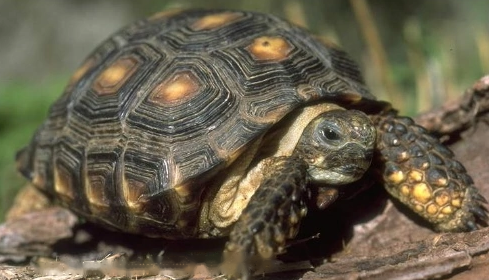
The Mexican gopher tortoise, also known as the yellow-margined sand tortoise, was first discovered in 1959. It is the largest tortoise species in North America, with a shell length of more than 40 cm. The vast majority of them are found in Mexico, with their original habitat in the Mapimi Basin of the Chihuahuan Desert.
In the early years, in the hometown of the Mexican gopher tortoise, the local aborigines liked to use their carapace as a container, so people hunted a lot, which once led to the almost extinction of the Mexican gopher tortoise. It was not until 1976 that the Mexican government began to build a protected area for this endangered species, teaching local residents how to protect the Mexican gopher tortoise. After being taught, hunters who used to hunt Mexican gopher tortoises are now assisting biologists in finding and caring for the little ones.
Currently the number of Mexican gopher tortoises in the wild is also slowly increasing , have become more optimistic about their future. Today, the author will give you some information about this guy:
1. Appearance characteristics
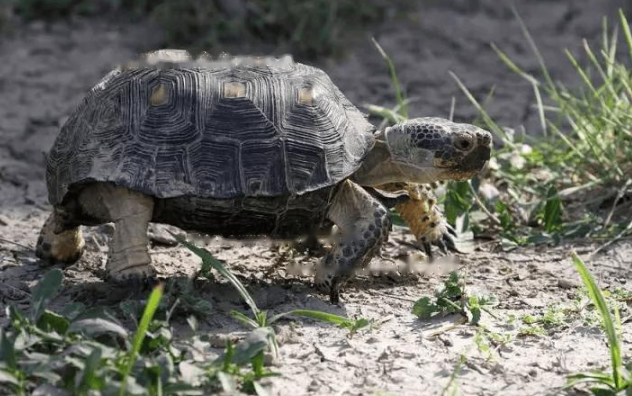
The Mexican gopher tortoise has some carapaces Yuanlong, its hind legs are short and sturdy, and its forelimbs are wrapped in thick scales, and the shape is somewhat flat. This shape is more convenient for daily excavation, and there are no webs between all toes. Their heads are small, brownish, slightly reddish with yellow-green irises, which feel like a traffic light.
Second, living habits
Mexican gopher tortoises like to live in burrows, although they already have thick shells to protect themselves, but they prefer Hide in caves to increase your sense of security.
What few people may know is that more than 80% of these caves are dug by male turtles, and female turtles are basically packed in. They are usually lazy in the cave and do not go out, and only go out for some time in the afternoon every day.
Three, gender discrimination
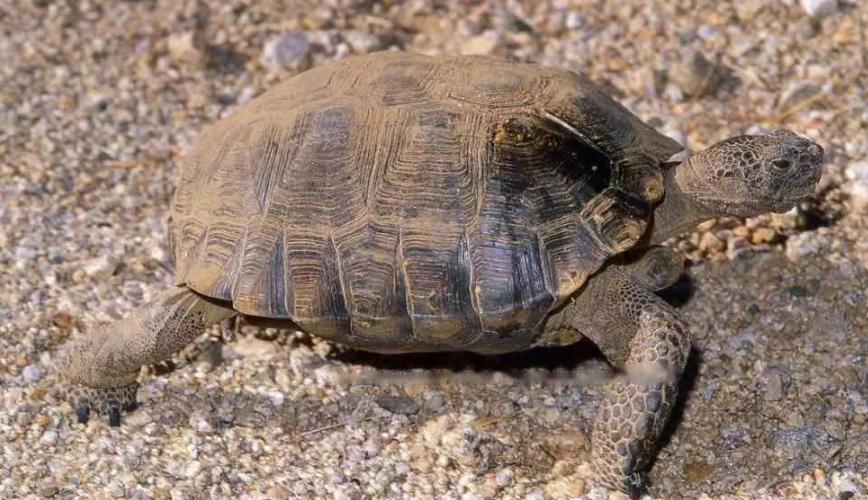
The female Mexican gopher tortoise has a protruding carapace, and the male's plastron is concave. This depression is not a physical defect. During the breeding and mating season, they will adopt the male-up and female-down posture. In order to avoid slipping off the female turtle's carapace during mating, this depression is just right to catch the female turtle's raised carapace.
Four. Reproduction
Mexican gopher tortoises usually lay about 12-15 eggs each time, and they still have many natural enemies in the wild. Those unhatched eggs or hatchlings that have broken shells are easily destroyed by wolves, badgers, stinky turtles Ferrets and eagles are eaten by these animals. Only about 3% of tortoises can grow safely, which is a severe test given by nature.
Although there are also precedents for artificial breeding, which may also be encountered in the domestic market, the author recommends that you do not buy and breed them casually. This kind of turtle is relatively large and is not suitable for mixing with other domestic turtles. of. Learn about them, and if you keep them, forget it~

![[Original] Sharing of popular science knowledge of ringed map turtles](/static/img/11249/11249_1.jpg)