The yellow-throated terrapin is a well-known turtle species and is very popular among people. Today, the editor wants to popularize its related information from seven directions, so that everyone can have an intuitive understanding of the yellow-throated water turtle. Without further ado, please look down~
[Chinese name] Yellow-throated water turtle
[Foreign name] Mauremys mutica
[Latin scientific name] Mauremys mutica
[Alias] stone turtle, stone money turtle, water turtle, yellow turtle, yellow turtle
[Kingdom] animal kingdom
【phylum】Chordates
【Subphylum】Chordates
【Class】Reptiles
【Subclass】Turtoises
[Order] Turtles
[Family] Turtle family
[Genus] Pseudomonas
[Species] Yellow Water Turtle
[Name and Date] Cantor, 1842
II. Appearance Features
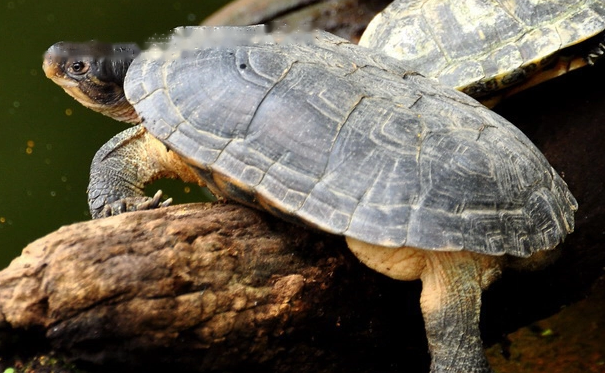
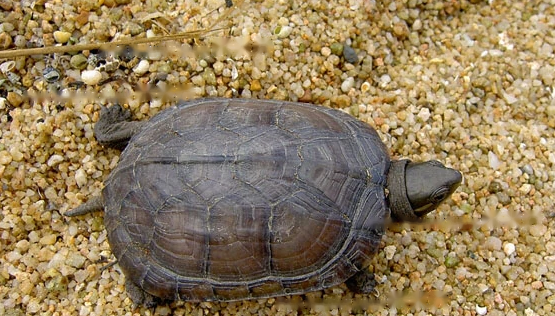
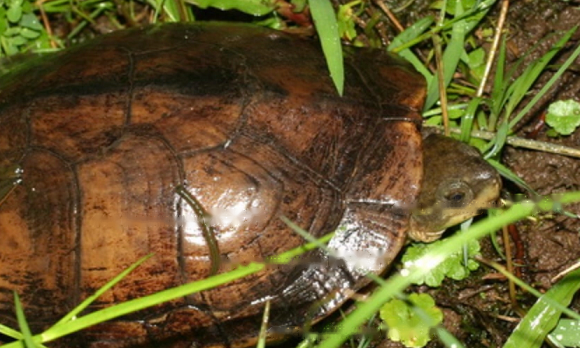
The Yellow-throated Water Turtle The top of the turtle's head is greenish-yellow, the ventral surface of the head and the throat are yellow, and there is a yellow longitudinal stripe on the side of the head from the back of the eyes along the upper and lower tympanic membranes; Slightly concave, tympanic membrane obvious.
The limbs are flat and gray-brown in color; the carapace is gray-brown or brownish-yellow in color, flat and flat, with 3 darker longitudinal edges; the cervical shield is small, trapezoidal, vertebral There are 5 shields. The first and fifth vertebral shields are wider in front and narrower at the back, in the shape of a pentagon. The rest of the scutes are wider than long and are hexagonal. There are 4 pairs of rib shields. Except the last pair, the rest are comparable. The adjacent vertebral shields are wide, with 11 pairs of marginal shields and 1 pair of hip shields, which are square; the color of the bridge and plastron are yellow, and there is a large square black spot in the middle of the rear edge of each scutellum, and the plastron is slightly shorter On the carapace, the front edge is bluntly concave and upturned, the rear edge is concave and deep, triangular, the throat shield is wedge-shaped, and the front side is convex and horn-shaped; the tail is short and thin, with yellow longitudinal stripes on the tail side.
PS: The male turtle's carapace is about 118-138 mm in length and 79-94 mm in width; while the female turtle's carapace is about 95-138 mm in length and 69-102 mm in width about.
III. Subspecies differentiation
There are 2 subspecies differentiation of the yellow-throated terrapin, namely the named subspecies of the yellow-throated terrapin and the Ryukyu subspecies of the yellow-throated terrapin.
IV. Distribution range
The distribution range of the yellow-throated terrapin is wide, both at home and abroad. Foreign countries are mainly distributed in Vietnam, Japan, the Ryukyu Islands, and domestic products are mainly distributed in Jiangsu, Zhejiang, Anhui, Guangdong, Guangxi, Hainan, Fujian and Taiwan.
V. Habits
1. Living habits
The yellow-throated terrapin mainly lives in hilly areas and mountains in the mid-mountain area It occurs in the waters of inter-basin and river valleys, and sometimes in scrub and paddy fields.
Every year in early March, when the temperature is about 15 degrees Celsius, the yellow-throated terrapin has woken up, but it is only crawling, not foraging. It will not eat until the end of March to the beginning of April. At the beginning of the month, its activity volume is relatively large. Under normal circumstances, the yellow-throated terrapin likes to stay in the water to play and forage during the day. On sunny days, it will climb to the land to bask in the sun. When it is hot, it will be active in the morning and evening. At noon and night, it will stay in water, in the dark or in the dark. Buried in the sand.
The suitable ambient temperature of the yellow-throated terrapin is 18-32 degrees Celsius, 13-15 degrees Celsius is the transition stage from its active state to the hibernation state, it will enter hibernation at about 10 degrees Celsius, and the temperature is 35-36 degrees Celsius. , will be dormant.
2. Eating habits
The yellow-throated terrapin is an omnivorous animal and will eat some animal meat and internal organs, as well as some plant fruits.
3. Breeding methods
The mating period of the yellow-throated terrapin is from April to the end of October. Male and female turtles generally choose to mate at night or in the early morning. Male turtles are more excited in the early mating period. , will follow behind the female turtle and hit the female turtle's shoulder with its head. When the female turtle does not move, the male turtle will climb on the back of the female turtle to mate.
The spawning period of female turtles is from May to September, and the spawning time is mostly at night. Before laying eggs, the female turtle will dig a hole (about 40 mm in diameter and about 80 mm in depth) with her hind limbs, and then align her tail to the cave to lay eggs. The long oval-shaped white eggs (about 40 mm in long diameter, 21.5 mm in short diameter, and about 11.9 grams in weight), after laying eggs, use their hind limbs to remove soil until the cave is filled up.
Six. Common diseases
1. White eye disease
The yellow-throated terrapin with white eye disease, the main symptoms are eyes Enlarged, inflamed and congested eyes, and erosion of the cornea and nasal mucosa due to inflammation. At this time, sick turtles often wipe their eyes with their forelimbs, and their movements become sluggish and food intake is reduced. In severe cases, the eyes may become blind, or even die.
2. Nail rot
Under normal circumstances, the surface of the carapace, neck, limbs and tail of the yellow-throated terrapin suffering from this disease will fester and turn black. There may be a problem of rotting into nicks or exposed bones.
3. Enteritis
Once the yellow-throated water turtle has enteritis, it is mainly manifested as poor mental state, slow response, decreased food intake, and possible inflammation of the abdomen and intestines Congestion problems, unformed stools. In severe cases, the feces are egg white, black or liver-colored, and the anus is red, swollen and turned outward.
4. Pneumonia
The main symptoms of the yellow-throated terrapin in the early stage of the disease are fever, difficulty breathing, dim vision, tears, runny nose, or blisters in the nose , the nostrils will even be crusted, the eye circles will turn white, and they will not like to exercise and eat. In severe cases, their lung abscesses, gangrene, and even death by suffocation.
VII. Population status
The number of wild yellow-throated terrapins is relatively small and has been recorded in many conservation lists, as follows:
1. World Conservation Union Red List of Threatened Species (IUCN 2000), endangered.
2. Convention on International Trade in Endangered Species of Wild Fauna and Flora (CITES Appendix II).
3. China's Biodiversity Red List - Vertebrate Volume (Reptiles), endangered.
4. The List of Terrestrial Wild Animals Protected by the State that is Beneficial or Has Important Economic and Scientific Research Value issued by the State Forestry Administration of China on August 1, 2000.
5. China's Red Book of Endangered Animals is endangered.
6.2000 Ministry of Agriculture revised China's National Key Protected Aquatic Wild Animal List, is a second-class protected animal.
7. List of Key Protected Wild Animals in Guangxi, China.
8. China's National Key Protected Wildlife List (only wild species), it is a second-class protected animal.
Okay , for the introduction of the yellow-throated water turtle, the editor will stop here. Guys, do you understand? If you have anything to add, please leave a message below~

![[Original] Sharing of popular science knowledge of ringed map turtles](/static/img/11249/11249_1.jpg)