The dead leaf turtle is a large aquatic turtle species that prefers to live in slow-flowing rivers, U-shaped lakes and ponds. Because of its special appearance, it looks like a dead leaf, hence the name. Seeing this, are you curious about it? Then, the editor will give you some popular information about this special turtle species, let's take a look~
1. Basic information
[Chinese name] withered leaf turtle
[Latin name] Chelus fimbriata
[English name] Matamata Turtle
[two names] Chelus fimbriatus
[other name] wither Leaf Turtle, Mata Snake-necked Turtle
【Kingdom】Animal Kingdom
【Domain】Chordates
【Subphylum】Vertebrate Subphylum
[Class] Reptiles
[Subclass] Turtles
[Order] Turtles
[Family] Snake neck Turtle family
[Subfamily] Long-necked tortoise subfamily
[genus] genus Psilocybe
[species] dead-leaf turtle
II. Appearance characteristics
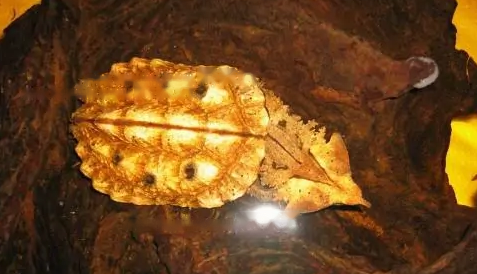
The dead-leaf tortoise is larger, generally about 43-45 cm in length, and the longest can reach 61 cm. The weight of an adult tortoise is 15 cm. about kilograms.
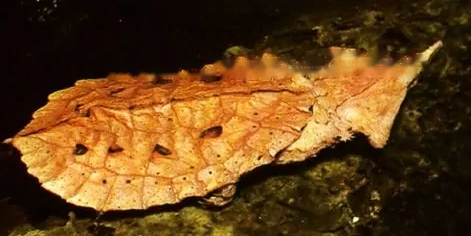
It has a distinctive head with a large triangular wedge shape and an arrow-shaped brown stripe in the center; skin wings extending from the tip of the nose to the back of the ends of the skull; the nose is slender and convex Eyes small; mouth wide and soft, not bulging.
The color of the head, neck, tail and limbs of the adult dead leaf turtle is gray-brown. Its neck is long and wide, with many symmetrical nerve-detecting tentacles and protruding spine-like flesh, and like the skinfold structure, there are many sensory cells and tactile nerves that can be used to receive signals of water flow.
The carapace has three regular strip-like ridges, which are conical in shape and have obvious concentric growth rings, which are uneven. Carapace rough, tuberous, and rectangular. The carapace of the hatchlings is brick red with 3 pairs of black spots; the plastron of the hatchlings is mostly pink; the carapace and plastron of the adult carapace will gradually disappear, and the bottom edge is a little red.
III. Distribution range
The leaf tortoise is mainly distributed in northern South America, including central and northern Brazil, Guyana, northern Bolivia, eastern Peru, Ecuador, eastern Colombia, Venezuela and other places.
4. Habits
1. Living habits
The dead-leaf turtle usually stays in the water, hardly basking in the sun or visiting Activities on land. When breathing, they stretch their necks and stick their stingers out of the water, never raising their noses beyond the surface of the water.
2. Eating habits
Leaf turtles are generally meat-based, mainly worms, snails, shrimp and small fish.
3. Predation method
The dead leaf turtle has the habit of preying at night. They will stay motionless in the water and use the ear drums on both sides of the head to feel the vibrations in the water, so as to confirm that the prey is in the water. Position in the water until the prey is close, then extend the head, open the mouth and widen the throat to swallow the prey directly.
4. Breeding method
The breeding season of the dead-leaf turtle is from October to December. Female turtles will crawl to the shore to lay eggs in summer. They can lay 12-28 spherical eggs (about 3.5 cm in length and 3.5-4 cm in diameter) each time. The eggs hatch in 7-10 months. .
Okay , About the introduction of the dead leaf turtle, the editor will stop here~ Do you guys understand?

![[Original] Sharing of popular science knowledge of ringed map turtles](/static/img/11249/11249_1.jpg)