The European pond turtle, also known as the European pond turtle, is a small and medium-sized turtle that is both aquatic and terrestrial. They can be clumsy on land, but once in the water they are standard swimmers!
However, it is a pity that, with the destruction of habitat and serious water pollution, the number of European swamp turtles has been decreasing year by year, and it has now been included in the IUCN Red List of Threatened Species (IUCN). 1996 ver 2.3) - Near Threatened (NT). However, such a rare turtle is worth knowing in detail. The following editor will introduce you to the European sea turtle!

I. Appearance characteristics
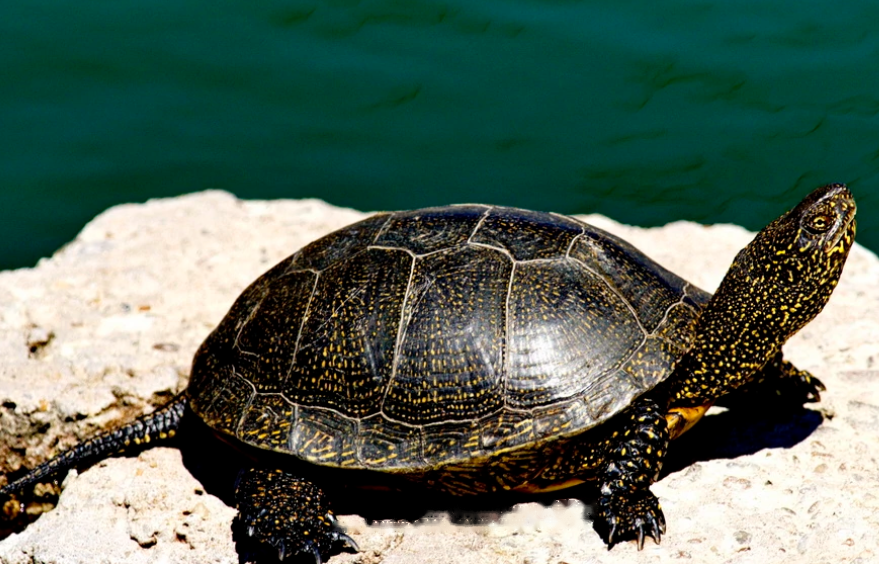
The body length of the European sea turtle is between 15-20 cm. The carapace of the larvae is rough and slightly keeled. becomes smooth. The carapace is usually tan with dense yellow spots and dark stripes, and the head, limbs and tail are dark. It is worth mentioning that the European sea turtles from different origins have great differences in body shape and body color pattern.
2. Habits
1. Habits
The European sea turtle is aquatic and likes to live in shallow lakes and swamps in the wetlands. The activity time is concentrated in the end of March to October. During the activity, they like to bask on the shore, small islands, floats or logs. Generally, when the temperature is lower than 10 ℃, they will enter the lethargy stage.
2. Eating habits
Basically, they are omnivorous turtles, mainly feeding on aquatic invertebrates, as well as aquatic plants, including small fish, small shrimp, raw meat, and mealworms and other animal foods, accompanied by a variety of vegetables, fruits and other plant foods. In adulthood, it will turn to a partial vegetarian diet. Due to the large food intake, the European sea turtle grows quickly and can grow into a large turtle in 3-4 years.
III. Breeding method
The reproduction of the European sea turtle mainly occurs in the water between March and April, and females may mate with multiple males in the same breeding season. The spawning period is from late May to early July each year. In warmer regions, female turtles can lay eggs three times a year.
4. Distribution range
1. Water range
Mainly distributed in the surrounding areas of the Mediterranean such as Europe and North Africa. It can be seen in most ponds.
2, countries and regions
In Albania, Algeria, Armenia, Austria, Azerbaijan, Belarus, France, Georgia, Germany, Greece, Hungary and other countries can see the European turtles figure.
V. Discrimination between male and female
It is still very easy to distinguish male and female tortoises. The size of male turtles is smaller than that of female turtles. And male turtles have thick tails and mostly reddish-brown eyes; female turtles have shorter tails and mostly yellow eyes.
An introduction about the European zebra turtle, come and get it~
Okay, the above is a brief introduction to the European sea turtles. I hope you can protect their homeland in the future.

![[Original] Sharing of popular science knowledge of ringed map turtles](/static/img/11249/11249_1.jpg)