The original specimen of the short-necked turtle was collected by Ludwig Preiss in 1839 and sent to the Vienna Museum. This specimen was labelled New Holland and described and named Pseudemydura umbrina by Seibenrock in 1901, and no specimens of them were found until 1953. It is an ancient species and is thought to have not changed much since the Miocene (23-5.3 million years ago). Much of the habitat has been cleared for urban or agricultural use. Due to the development of farmland, housing and mining, many Australian short-necked turtles are so rare that they were once mistaken for extinction. Here is a brief introduction to the Australian short-necked turtle.
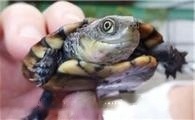
Let's Let's take a look at the basic information of the Australian short-necked turtle
[Chinese name]Australian short-necked turtle
[English name]Pseudemyduraumbrina
[Distribution] The scattered plains of Western Australia, from Perth Airport to Bullsbrook near the Royal Australian Air Force Base.
[Classification] Chordates, Reptiles, Turtles
Physical characteristics of the Australian short-necked turtle
Body size: Male turtle shell is 155mm long and weighs 550g; female turtle shell is 135mm long and weighs 410g.
Morphological characteristics: Color ranges from tawny in mud marshes to almost black in sandy marshes. Breastplates also vary in color, ranging from yellow to brown, and sometimes even black. The edge of the shield is black, and the interior is yellow with black spots. Their feet are short, covered with scaly shields, and have claws on the toes. They have short necks with angled nodules. There is only a large shield above the head.
Character Traits: Very lively, it will take food from your hand after a week of feeding, and then it will stop in front of the aquarium when you enter the room swim, and it will swim out of the water when you get close to it.
Protection level: IUCN Red List: Critically Endangered (CR)
Life Habits of the Australian Short-necked Turtle
Habitat: In swamps, lakes, tributaries of rivers, and slow-flowing waterways.
Diet: Eat only live food, including small crustaceans, insect larvae and tadpoles. In captivity, they need vitamins, raw lean meat, mice and dry dog food.
Breeding: Nests in spring or early summer, laying 8-24 eggs, hatching for about 3-4 months.
Introducing here, the editor wants to say: the earth is not only the homeland of human beings, but also the homeland of all living things. Please don't destroy the living environment of wild animals.

![[Original] Sharing of popular science knowledge of ringed map turtles](/static/img/11249/11249_1.jpg)