Serrata is a semi-aquatic turtle. It lives in mountainous areas, jungles, bushes and creeks. It can be said that the serrata is the most land-oriented among all semi-aquatic turtles, so it is considered a better semi-aquatic turtle. Although its appearance is not very high, but the type A is more distinctive, many turtle friends like it, and friends who keep turtles affectionately call it a saw. So how to choose a healthy serrata before raising it? Interested friends, please see the selection skills brought by Xiaobian.
1. Look at the morphological characteristics
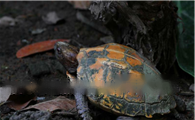
1. Body size: Serrata serrata is medium in size among semi-terrain turtles, with a carapace length of 130-159 mm, a moderate head size, smooth skin on the top of the head, and a head After the skin splits into scaly.
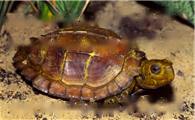
2. Carapace: The carapace is relatively flat and light brown with three distinct ridges on it.
3. Plastron: The plastron is pale brownish yellow, the dorsal and plastron are connected by ligaments, there are obvious ligaments between the anterior and posterior lobes of the plastron, and the anterior lobe of the plastron can completely close the carapace.
4. Limbs: The forelimbs are relatively flat, and the front edge is covered with large imbricate scales; the hindlimbs are round, and the lower part is covered with imbricate scales.
5. Head: The back of the head is light brownish yellow with dark stripes; the color of the head is relatively dark, except for the dark stripes, each side has a temporal point with a dark edge.
PS: When choosing, carefully compare the above morphological characteristics. If the difference is large, it is not recommended to start.
II. Look at the health status
1. Look at the mouth and nose: Observe whether there is foamy secretions at the mouth and nose of the serrata, if there is, it means that it may be infected with respiratory diseases.
2. Look at the state: A healthy Serrata tortoise is cautious, responds quickly to external stimuli, has bright eyes, walks powerfully and quickly on all fours, and has a high plastron from the ground. Make a whistling gasp as a warning. You must know that the serrata is still quite grumpy. If you pick it up and it doesn't resist or struggle, it may be too weak and it is not recommended to choose.
Most of the turtles are wild turtles, and turtles have many natural enemies in the wild, so it is inevitable that there will be bumps and other scars on the body. If it is an old wound, it is not a big problem. Bacteria will be infected during transportation and will form rotten armor, so you should pay attention when purchasing. My suggestion is to buy a flawed but healthy turtle rather than a beautiful turtle with a safety hazard.

three. Look at the purchase channels
Serrata serrata can be purchased on e-commerce platforms and aquatic product markets. We try to choose physical stores to buy, so that we can better see the health of Serratia serrata In this case, if there is a chance, it is more reliable to buy turtles raised by turtle friends.
The above is a little knowledge of the selection of the Serrata tortoise. Friends who want to buy it can refer to it. I wish you all to choose the one you like.

![[Original] Sharing of popular science knowledge of ringed map turtles](/static/img/11249/11249_1.jpg)