The serrata, commonly known as the serrata tortoise. There are no gorgeous colors on its body, mainly dark colors, usually living in mountains, jungles and streams, and the probability of contact in daily life is not large. Therefore, in order to let everyone know about it, the editor will give a brief introduction to the serrata from six aspects. Let's look down~
One 、Basic information
【Chinese name】Serrata serrata
【Latin name】Cuora mouhotii
【English name】Keeled Box Turtle
【Another name】Saw-edge turtle, octagonal turtle, octagonal turtle, square turtle, saw-edge box turtle
[Kingdom] Animal Kingdom
【 Door: Chordate
【Subphylum】Vertebrate Subphylum
【Class】Reptiles
【Subclass】Turtle subclass
[Order] Turtles
[Family] Turtles
[Genus] Turtles
[Species] Turtles serrata
[Subspecies] Nominated subspecies of Tortoise serrata, Subspecies of Tortoise serrata (Vietnamese subspecies)
[Named by] Gray
[Named time] 1862
Second, the main distribution
The distribution range of Serratia tortoises is wide, both at home and abroad. Foreign countries are mainly distributed in Southeast Asian countries, including India, Laos, Myanmar and Vietnam, and domestic products are mainly distributed in Guangdong, Guangxi, Hainan, Hunan, Yunnan and other places.
III. Morphological characteristics
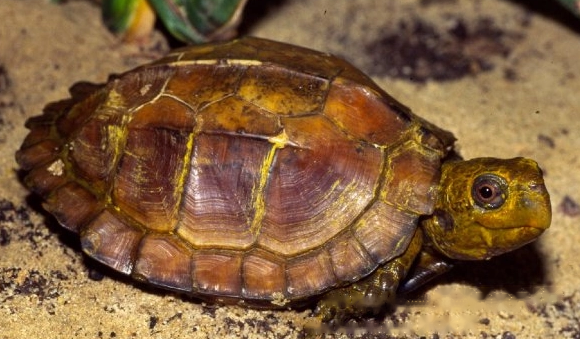
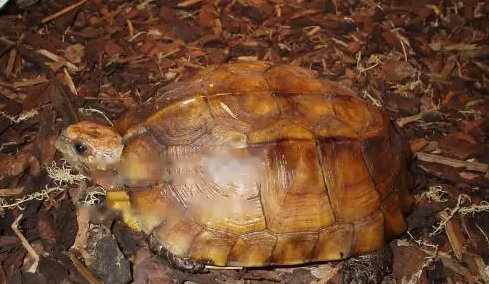
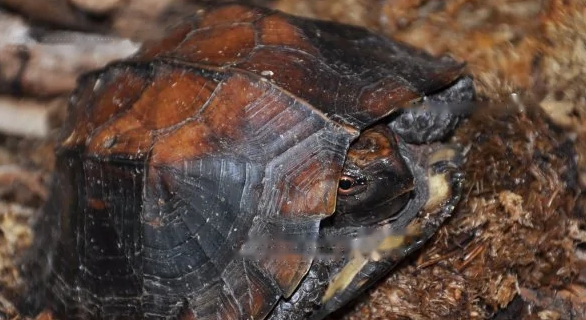
The serrata is medium in size; the head is moderate in size, the top of the head is smooth, the back of the head is light brown, and there are Dark worm-etched patterns; darker sides of head with light worm-etched patterns and a small temporal point each with a dark edge; eyes larger; tympanic membrane distinct.
The carapace is relatively raised, light brown or yellow-green in color, about 130-159mm in length and 82.6-113mm in width; there are 3 obvious ridges in the center of the back, radiating light brown outwards fine lines; the front and rear edges of the carapace are serrated.
The plastron is slightly smaller than the carapace, brown or yellow in color; the outer edges of each scutellum sometimes have dark spots; the bridge of the carapace is short and distinct, and there is no axillary shield.
The limbs have large imbricate scales; the forelimbs are flat with 5 claws, and the hind limbs are round with 4 claws; the tail is medium in size.
Fourth, male and female identification
1. Body size: Compared with the same age, female turtles are generally larger than male turtles.
2. Plastron: The center of the plastron of the female turtle is flat, and the center of the plastron of the male turtle is concave.
3. Tail: Female turtles have short and thin tails, while male turtles have longer and thicker tails.
4. Cloacal hole: The cloaca of female turtles is closer to the rear edge of the plastron, while the male turtles are farther away.
V. Habits
1. Living habits
Serrata likes warm and is afraid of cold, when the ambient temperature is 19 degrees Celsius and Below, they will go into hibernation; at 25 degrees Celsius, they can eat normally; at 28-31 degrees Celsius, they will eat a lot.
2. Eating habits
The serrata is a carnivorous turtle and likes to eat some live food, such as locusts, mealworms and earthworms.
3. Reproduction
In late April every year, male turtles that reach sexual maturity will experience symptoms such as loss of appetite and restlessness. At this time, when male turtles meet female turtles, they will perform back-climbing mating behavior; May-June of each year is the peak mating period of male and female turtles, and June-July is the egg-laying time of female turtles; Lays 2-4 long oval white eggs.
VI. Status of the population
Due to the destruction of the habitat and the mass killing of humans, the number of wild serrata has become less and less, and has been Included in a number of protected lists, as follows:
1. World Conservation Union Red List of Threatened Species (IUCN 2000), endangered level.
2. Convention on International Trade in Endangered Species of Wild Fauna and Flora (CITES Appendix II).
3. China's Biodiversity Red List - Vertebrate Volume (Reptiles), as critically endangered.
4. The List of Terrestrial Wild Animals Protected by the State that is Beneficial or Has Important Economic and Scientific Research Value issued by the State Forestry Administration of China on August 1, 2000.
5. List of Key Protected Wild Animals in Guangxi, China.
Okay, about the serrata, Xiaobian said it here! Do you understand?

![[Original] Sharing of popular science knowledge of ringed map turtles](/static/img/11249/11249_1.jpg)