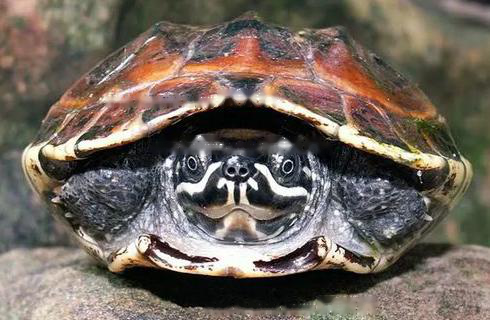
Classic Peking Opera appearance, simple appearance, how about it, does it have a strong Chinese flavor? ! Next, let Xiaobian take you to a simple understanding of it.
I. Basic information
[Chinese name] snail-eating turtle
[Latin name] Malayemys subtrijuga
【English name】Snail-Eating Turtle
【Kingdom】Animal Kingdom
【Domain】Chordates
【Class】Reptiles
[Order] Turtles
[Family] Turtleidae
[Genus] Snail-eating Turtles
[Species] Snail-eating turtle
[Main distribution] Cambodia, Indonesia, Laos, Malaysia, Southeast Asia and other places
II. Appearance characteristics
1. Body size: The snail-eating turtle is medium in size, and the carapace can be as long as 21cm.
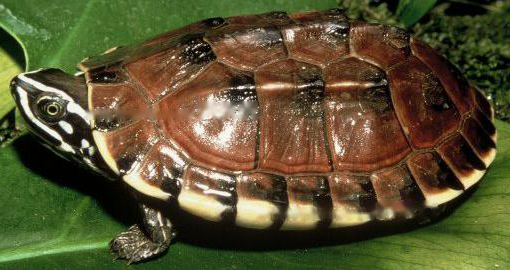
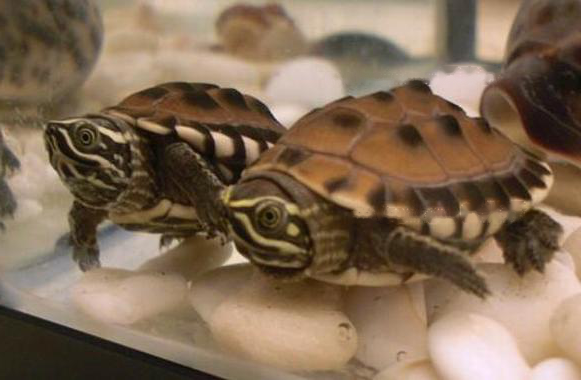
2. Head: The head is broad, generally black, with a V-shaped white stripe on the edge of the top of the head, extending from the tip of the nose to the neck, also under the eyes, nostrils There are four white vertical stripes at the place, two of which are connected to the muzzle, which looks especially like the masks in Peking Opera. The snout is broad and blunt.
3. Tortoise shell: The carapace is black, with three ridges in the center, black patches on each scutellum, and the edges of the scutellum are yellow. The plastron is smooth and flat, without depressions.
4. Limbs: The limbs are flat, with webbed feet and toes. The toes are distributed in five forelimbs and four for hind limbs.
3. Habits
1. Habitat
The snail-eating turtle mainly lives in slow-flowing streams and swamp areas, and it can even be found in rice fields sometimes .
2. Eating habits
As the name suggests, snail-eating turtles feed on small crustaceans. They like to eat snails, field snails, and some small fish and earthworms.
3. Breeding method
The breeding method of snail-eating turtles is oviparous, and breeding and mating begin in April. Female turtles can lay 3-6 eggs at a time at a temperature of 29 degrees. Hatchlings hatch in about 70 days.
4. Personality: Snail-eating turtles are sensitive, timid and gentle, and have weak adaptability to new environments. If it is kept by individuals and not cared for carefully, it is easy to stop eating and not eat, resulting in its death. PS: It is not recommended for novice feeding.
4. Ethnic Discovery
It is generally believed that there is only one species of snail-eating turtle (Malayemys subtrijuga). Previous taxonomic data believed that the Mekong snail-eating turtle distributed in the upper reaches of the Mekong River. (Malayemys macrocephala) is only a synonymous species of the Malayan snail-eating turtle. In recent years, it has been identified as an independent species through technical means such as mitochondrial identification.
Afterwards, another species of snail-eating turtle was discovered in Nakhon Ratchasima in the northern East China Sea in 2016. In 2017, it was published on ICZN and named Malayemys khoratensis.
V. Protection level
The snail-eating tortoise is a protected animal and was listed in the World Conservation Union (IUCN) Red List of Threatened Species - Vulnerable (VU) in 2000.
Okay, the above is all the information about the snail-eating turtle. You are welcome to come to supplement and discuss.

![[Original] Sharing of popular science knowledge of ringed map turtles](/static/img/11249/11249_1.jpg)