The grass snake, also known as the water snake, is a type of non-venomous snake. I believe there are many friends who don’t know much about it, so let me introduce it to everyone~I. Basic information
Chinese name: grass snake
Latin Scientific name: Natrix natrix Linnaeus
Kingdom: Animalia
Department: Chordate
Subphylum: Vertebrate subphylum
Class: Reptiles
Subclass: Biporia
Order: Snakes
Suborder: Neospermia
II. Appearance characteristics
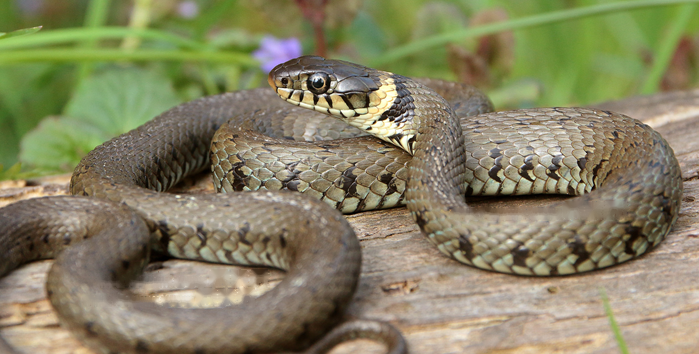
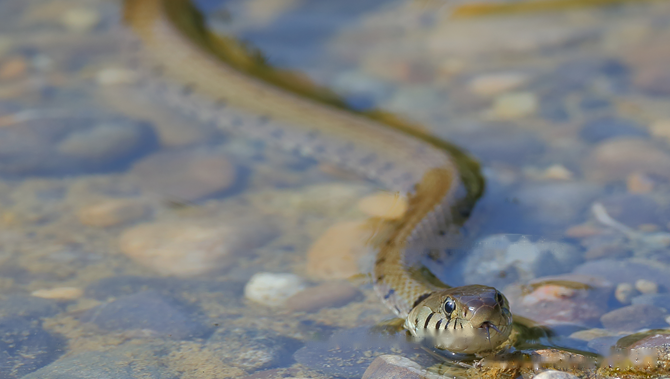
Grass snake is a large snake species with a body length of about 120 cm. It is known that some individuals can reach 200 cm in length.
The body surface of the grass snake is olive green; the ventral surface is grayish-white, and each ventral scale has 1-4 triangular black plaques, and some individuals also have many black patches on the ventral scales. point.
III. Distribution range
The grass snake is mainly distributed in China, Albania, Armenia, Austria, Azerbaijan, Denmark, Estonia, Finland, France, Georgia, Germany, Greece, Hungary, Iran, Italy and the UK.
Four. Life Habits
1. Grass snakes mainly live in various waters such as streams, lakes, ponds, swamps and ditches; sometimes they also appear in grasslands, wetter wilderness, gardens and parks and so on.
2. The body temperature of grass snakes depends on the supply of the outside world; in the early morning, they will go to a warm place to bask in the sun, and after reaching enough body temperature, they will move or digest food normally.
3. The hibernation period of the grass snake is from October to March and April of the next year; during this period, the grass snake will look for places without frost accumulation as a place for hibernation, such as rock piles or relatively In deep, thick leaves.
V. Breeding method
The reproduction method of grass snakes is oviparous, and their courtship and mating time is from March to June every year; female grass snakes 10-52 eggs can be laid at a time.
6. Natural enemies
Grass snakes have many natural enemies, including foxes, cats, badgers, porcupines, and birds. When encountering these animals, the grass snakes will play dead to protect themselves; if they are accidentally caught, the grass snakes will hiss as loudly as possible, and the anal glands will release a relatively foul smell, A pungent substance; in addition, it frequently hits predators with its head, but does not bite them.
7. Racial Status
This species is well protected by law in many countries, so swimming snake populations thrive in its protected areas. At present, the aquatic snake is listed in the World Conservation Union (IUCN) 2009 Red List of Threatened Species ver 3.1 - Least Concern (LC)
This article ends here~ Thank you for reading ! If there is anything you don't understand, please leave a message in the comment section below.

![[Original] Sharing of popular science knowledge of ringed map turtles](/static/img/11249/11249_1.jpg)