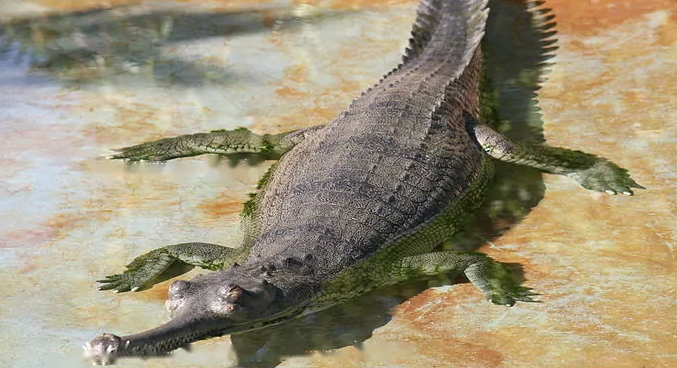
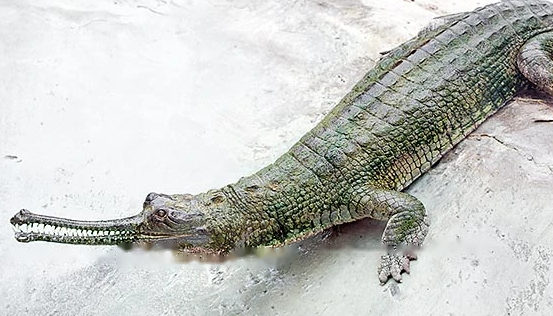
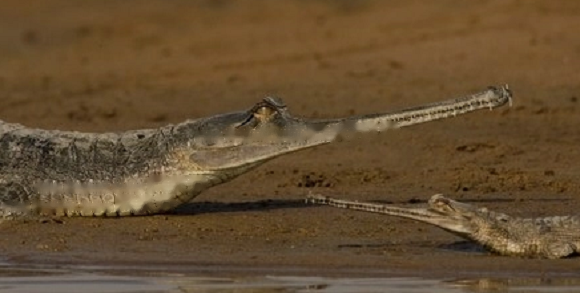
The Ganges crocodile, also known as the fish-eating crocodile or gator, is mainly distributed in the Ganges River Basin in India. Its special feature is that it has a long and thin nose, which is specially used for fishing, but with age, the shape of the nose will become thinner and thinner.
Then, I will give you some other information about it. Let's take a look~
I. Basic information
【Chinese name】Gangetic crocodile
【Latin name】Gavialis gangeticus
【Kingdom】animal Kingdom
【phylum】Chordates
【Subphylum】Vertebrate subphylum
【Class】Reptiles
【Subphylum Class: Biporia
[Order] Crocodiles
[Family] Alligatoridae
[Genus] Ganga
【Species】Ganga crocodile
【Named person】Gmelin
【Named time】1789
II. Appearance characteristics
The Ganges crocodile is larger in size, with an average body length of about 4 meters; the main color of the body is olive green; the snout is relatively broad; the upper and lower palate is relatively slender; Sharp, with 5 upper jaws, 23-24 upper jaws, and 25-26 lower jaws.
III. Habits
1. Habitat
The Ganges crocodile is a freshwater crocodile and likes to live in the Ganges, Indus, Maharadi and Brahmaputra Rivers and other rivers with fast-flowing water and good water quality.
2. Eating habits
The larvae of the Ganges crocodile mainly eat some insects and frogs; the adults mainly eat some fish and occasionally some carrion.
3. Breeding method
The reproductive method of the Ganges crocodile is oviparous. Female crocodiles reach sexual maturity around 8 years old, male crocodiles reach sexual maturity around 15 years old, and their mating time is in February of each year. The spawning time of female crocodiles is from March to April every year, and each time can lay 30-40 eggs.
IV. Status of the population
Due to the mass killing of humans, the number of Ganges crocodiles has decreased sharply. At present, it has been recorded in a number of protection lists, as follows:
1. International Union for Conservation of Nature Red List (IUCN), as critically endangered.
2. The Washington Convention (Appendix I to CITES).
3. Convention on the Conservation of Migratory Species of Wild Animals (Appendix I of the CMS).
Okay, the Ganges The introduction, the editor will stop here! Do you guys understand?

![[Original] Sharing of popular science knowledge of ringed map turtles](/static/img/11249/11249_1.jpg)