When it comes to Thunder Monkey, many people think that Thunder Monkey and Thunderbolt are related, but they have nothing to do with each other. Thunder monkeys, also known as humming monkeys, wind monkeys, and slow loris, are monkeys with a body length of about 30 centimeters. The reason why it is called loris is because during the day, the thunder monkeys often sleep soundly in the canopy, branches or tree holes of tall trees, and move slowly. So what are the characteristics of the small, slow-moving thunder monkey? Let's take a look together.
1. Morphological characteristics
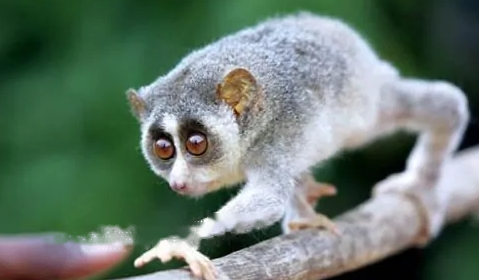
The head of the thunder monkey is round like a cat. The face is white. The eyes are round and large, with brown-black hairs around them, as if they were wearing sunglasses. The mouth is pointed, the ears are small, and the tail is short. Body hair is short and dense. Back grey-brown, belly brown. There is a brown longitudinal stripe in the center of the back. Inhabits tropical rain forests or subtropical dense forests, lives entirely in trees, and is strictly nocturnal. They huddle together during the day, sleep in trees, and forage at night. The movement is slow and silent. The diet is very mixed, mainly insects and birds, but also eat shoots, wild fruits and so on. Thunder monkeys are evidence of the evolution of lower animals to higher animals.
2. Living habits
Thunder monkeys sleep with their heads in tree holes and tree trunks during the day because of photophobia and heat, and the birds and animals roar. Couldn't wake it up. It moves very slowly, and it seems to stop two when it takes one step. Someone once observed that it took 12 seconds for the Thunder Monkey to move a step.
Thunder monkeys move slowly, but they also have a unique way to protect themselves. Because the thunder monkey is rarely active all day long, lichens or algae can continuously absorb the water vapor and carbonic acid gas emitted by it, and actually multiply and grow on the thunder monkey, wrap it tightly, and make it have a harmonious atmosphere. The protective clothing with the same color in the living environment is difficult to be found by the enemy. Therefore, it is also called a monkey, which means that it can simulate green plants and avoid damage from natural enemies.
3. Living environment and distribution
Inhabiting tropical and subtropical forests: always living on trees, rarely going to the ground, not accustomed to high temperature And low temperature: nocturnal activities can hang upside down on the branches: eat all kinds of wild fruits, young leaves, insects, birds. Eating bird eggs and locusts. Raised in the zoo, they like to eat bananas, apples, lychees and other fruits, as well as locusts, pigeon eggs, quail eggs and drink milk. : Mating throughout the year, gestation period of 5 to 6 months. Most of the calving occurs in winter, and it can be seen that it breeds in summer and autumn. 1 cub per litter. Like other monkeys, the young monkeys hold tightly to the arms of the mother monkeys and can live independently until they reach the size of the adult monkeys. Domestically, it is distributed in southern Yunnan (Xishuangbanna and Lincang) and southern Guangxi. In foreign countries, it is distributed in northeastern India, Bangladesh, Myanmar, Thailand, Vietnam, Laos, Cambodia, Malaysia, the Philippines, and Java, Sumatra and Kalimantan in Indonesia.
4. Protection level
Thunder monkeys are very easy to domesticate ornamental animals, and at the same time have certain medicinal value. However, the distribution area is narrow, the reproduction rate is low, and the number is scarce, and it is already in an endangered state. It is a national first-class protected animal and is strictly prohibited from hunting.
Okay, the above is the basic introduction about Thunder Monkey, and interested friends can learn about it.

![[Original] Sharing of popular science knowledge of ringed map turtles](/static/img/11249/11249_1.jpg)